
E-commerce AI SEO: A Human-Reviewed Workflow for Category Pages and AI Search
For many small e-commerce stores, E-commerce AI SEO sounds simple at first: instant content and fast layouts. But the reality for category pages is often different. AI can indeed create category copy at high speed. The problem is that quick copy frequently sounds generic, misses the specific buyer questions your customers have, and ultimately fails to help them decide. It is a common challenge for founders and lean marketing teams: how do you leverage AI’s efficiency without sacrificing the human touch that converts visitors into buyers?
At Pro Prompt Flow, we see E-commerce AI SEO as a reviewable workflow, not a content shortcut. Successful category optimization is less about generating bulk text and more about structuring information. To illustrate this, we will use a running example throughout this guide: optimizing a category page for durable hiking boots.
What E-commerce AI SEO Means Now
E-commerce AI SEO today is far more than just generating descriptions with an AI tool. It is about creating a structured, clear experience on your category pages that both human customers and search systems can parse easily. This is where reusable AI prompts for e-commerce can help teams keep the process consistent. This means moving beyond simple AI-written paragraphs and focusing on how AI can help you structure information to answer buyer questions.
Why Category Pages Need a Different AI Workflow
Category pages are unique in the e-commerce journey. Product pages need their own workflow, which is why we separate category-page structure from ChatGPT prompts for product descriptions. Category pages serve a crucial role in guiding decision-making. They help buyers:
- Compare different options within a product group (e.g., trail runners vs. heavy backpacking boots).
- Filter based on specific needs or attributes (e.g., waterproof lining vs. breathability).
- Understand the nuances and benefits of a range of products.
- Choose a direction or narrow down their search.
Because of this comparative and directional nature, generic AI content often falls short. It lacks the specific insights needed to help a customer navigate choices. This is where a human-reviewed AI workflow becomes essential: to ensure these pages are truly helpful.
Before and After: The Impact of Human Review
To see the difference human review makes, look at these two approaches for our “durable hiking boots” category page:
1. Generic AI Category Copy (Unreviewed)
“Welcome to our collection of durable hiking boots. We have the best boots for hiking. Buy our durable hiking boots today for maximum comfort and durability. Our boots are perfect for all your outdoor adventures and trails. Shop now for great deals on hiking footwear.”
2. Human-Reviewed Improved Version
“Finding the right hiking boots depends on your trail style. If you are preparing for multi-day backpacking trips with heavy loads, you need stiff outsoles and high ankle support. For weekend day hikes, a lightweight, flexible mid-boot is often more comfortable. Below, we break down our collection by weight, water resistance, and trail suitability to help you find the correct fit.”
The human-reviewed version helps the user navigate, whereas the generic copy simply repeats keywords.
The Human-Reviewed AI SEO Workflow
Building helpful e-commerce category pages with AI requires a structured, six-stage approach that keeps human insight at the center. In practice, E-commerce AI SEO works best when each stage can be reviewed before content reaches the page:
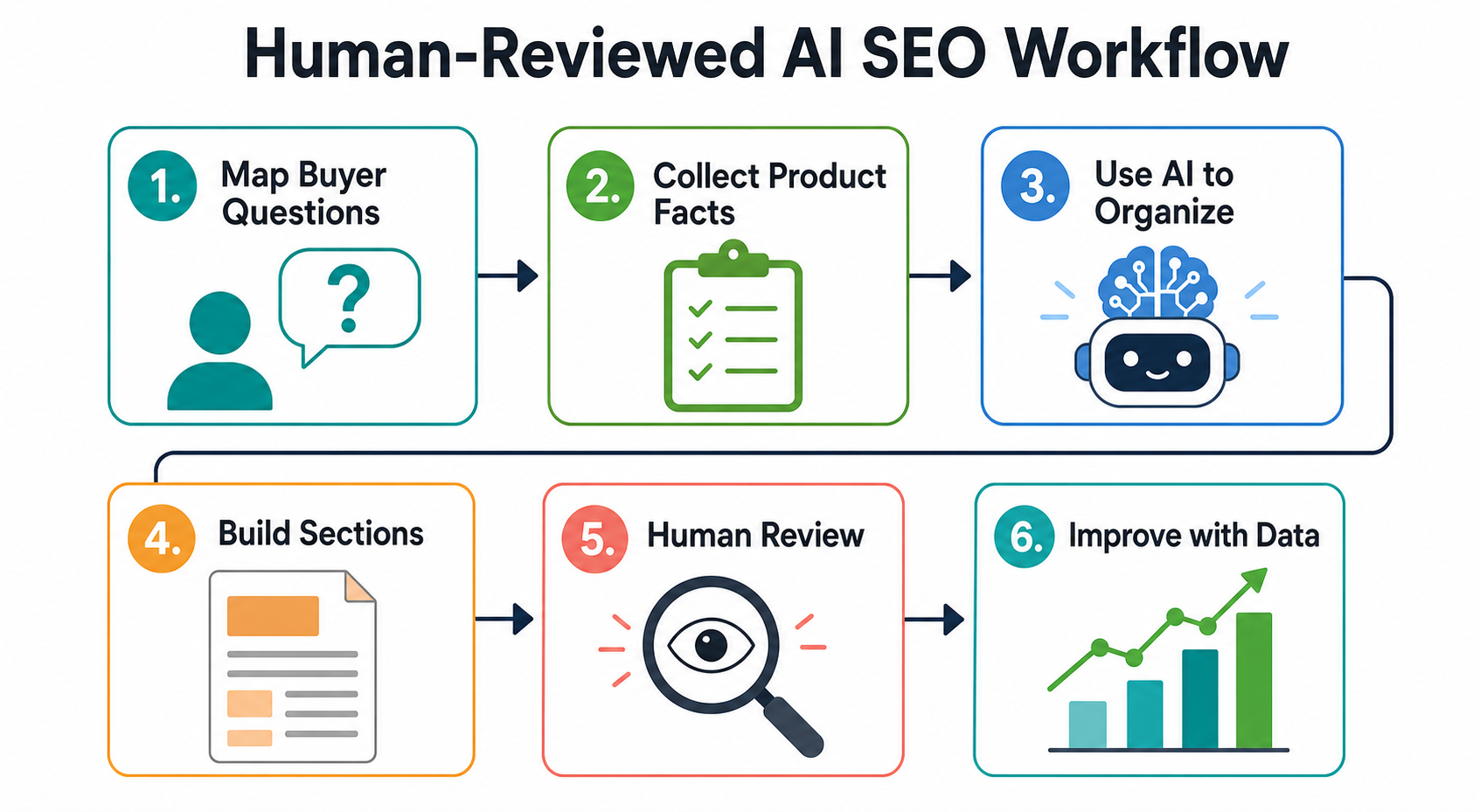
Stage 1: Map Buyer Questions Before Using AI
Start with your customer, not the AI. What questions do buyers ask when considering products in this category? For durable hiking boots, they might ask: “Are these boots crampon-compatible?” or “How long does the outsole last before wearing down?” Interview customers, review support tickets, and analyze competitor FAQs to collect these questions. For deeper workflow support, use AI customer review analysis to turn repeated buyer objections into product FAQs that strengthen product and category pages.
Stage 2: Collect Product/Category Facts
Gather all the factual information about the category. This includes common product attributes, features, benefits, use cases, target audiences, and any unique selling propositions. Centralize this data so AI has accurate, specific details to work with, avoiding the common mistake of AI making up technical details.
Stage 3: Use AI to Organize Themes and Content Blocks
This is where AI excels: taking your collected buyer questions and product facts and structuring them. Use AI to identify key themes and propose a logical flow for your category page. Don’t ask it to write the final copy yet. Instead, ask it to outline. For example:
"You are an expert e-commerce content strategist. For the 'durable hiking boots' category, based on the following buyer questions: [list 3-5 key questions] and these core product facts: [list 5-10 facts/attributes], propose 5 distinct content blocks and their primary themes for a category page. Focus on comparison, problem-solving, and guiding the customer."This prompt guides AI to think structurally, not just generatively.
Stage 4: Build Category Page Sections
Once AI provides a structured outline, use it to build out the different sections of your category page. To execute this step reliably, use a structured generation prompt rather than a generic writing request:
"Using the approved category page structure below, draft a short buying guidance section for the 'durable hiking boots' category. Use only the provided product facts and buyer questions. Do not invent claims. Keep the tone practical and helpful."This means filling in the content blocks with clear, concise, and helpful information. You might use AI to draft short paragraphs for specific sections, but always with the output from Stage 3 as your guide.
Stage 5: Human Review for Accuracy, Usefulness, and Brand Voice
This is the most critical stage. Every piece of AI-generated content needs a thorough human review. Establishing these human review boundaries helps small teams align with a broader e-commerce AI safety framework to prevent unverified claims. Check for:
- Accuracy: Are all claims and product details factually correct?
- Usefulness: Does the content genuinely help buyers make a decision? Does it answer their real questions?
- Brand Voice: Does it sound like your brand? Is it authentic, clear, and engaging, rather than generic or robotic?
Stage 6: Improve with Performance Data
Your work isn’t done after publishing. Monitor how your category pages perform. Look at conversion rates, time on page, bounce rates, and click-throughs to internal product pages. Using actual performance metrics to drive improvements is a core habit when setting up AI workflows for e-commerce. Use this data to identify areas for improvement.
Category Page Content Blocks
Effective category pages often include a combination of these blocks, arranged logically to guide the buyer:
| Category Page Block | Purpose | Human Review Question |
|---|---|---|
| Short Category Intro | Explains what the category offers and who it is for. | Does this immediately address the core buyer need? |
| Buying Guidance | Helps customers understand key considerations. | Is this advice practical for a beginner? |
| Comparison Section | Compares sub-categories or popular product types. | Are the comparison criteria objective and clear? |
| FAQ Section | Directly answers common buyer questions. | Are these answers factual and free from fluff? |
| Internal links | Guides buyers to related products, subcategories, or helpful guides. | Does this link help the buyer take the next logical step? |
| Trust signals | Supports confidence through warranty, return policy, reviews, or service information. | Is the trust information accurate and not exaggerated? |
AI Search Readiness
The rise of AI Search experiences like Google’s AI Overviews and AI Mode means that search engines look for structured, clear, and directly answerable content. For E-commerce AI SEO, a structured layout also simplifies handoffs if pages need to sync with conversational tools, similar to how teams organize data for AI agents for e-commerce customer support. For broader context, see Google’s AI features guidance.
When your content provides clear answers to specific questions, organizes information into structured sections (like FAQs or comparison tables), clearly outlines product attributes, and uses thoughtful internal linking, it can become easier for AI search systems to interpret and summarize. Where appropriate, structured data and clean page hierarchy can also help search systems interpret the page context more clearly. This clarity can make your page easier for humans and search systems to interpret, without treating AI Search visibility as guaranteed.
Human Review Checklist
Before any E-commerce AI SEO category page goes live, run it through this critical human review checklist:
- Are claims and product details accurate?
- Does the copy answer real buyer questions?
- Is the content useful and different from generic competitor pages?
- Does it avoid keyword stuffing and unsupported claims?
- Are internal links genuinely helpful?
- Does the page have a clear next step?
Common Mistakes to Avoid
When using AI for e-commerce category pages, watch out for these pitfalls:
- Publishing AI copy without review: This often leads to inaccuracies, generic language, and missed opportunities to connect with buyers.
- Turning category pages into keyword dumps: Focus on natural language and helpfulness, not just repeating keywords.
- Repeating product description content: Category pages should summarize and guide, not list every detail of every product.
- Ignoring buyer objections: If customers have common hesitations, AI content might miss addressing them. Human review catches this. Treating SEO pages as keyword traps misses the broader goal of cohesive messaging, which we discuss in our breakdown of AI prompts for e-commerce marketing.
- Using AI to invent claims: AI can fabricate information. Always fact-check.
- Treating AI Search as a shortcut: AI Search readiness is better supported by clarity and depth, not AI-generated noise.
Final Takeaway
An E-commerce AI SEO workflow can add real speed to content creation, but for e-commerce category pages, speed alone isn’t enough. The real power comes from a human-reviewed workflow that combines AI’s ability to organize and structure with your unique understanding of your customers and products. This approach ensures your content is not only efficient to produce but also genuinely useful, safe, and trustworthy for your buyers, ultimately helping buyers make clearer decisions.
Ready to streamline your e-commerce content operations? Book a Free AI Workflow Audit to review where your current AI content process may be weak. You can also Download the AI Workflow Starter for practical tools and templates.
FAQ
Q1: Can AI fully write my e-commerce category pages?
No. While AI can draft and structure significant portions of the content, it cannot verify facts, capture your true brand voice, or accurately answer specific buyer questions without human intervention. A human-in-the-loop review ensures accuracy and maintains customer trust.
Q2: How does this workflow help with Google’s AI Overviews?
This does not guarantee AI Overview inclusion, but it makes the page clearer, better structured, and easier to interpret.
Q3: Why focus on buyer questions before using AI?
Starting with buyer questions ensures your category page content is customer-centric and genuinely useful. For example, knowing that buyers ask about boot weight helps us focus the AI on creating comparison tables for different weights rather than generic paragraphs.
Q4: Is this workflow only for large e-commerce businesses?
No, this workflow is designed specifically for small e-commerce founders, Shopify/WooCommerce store owners, and lean marketing teams. It helps them leverage AI’s efficiency while maintaining the high quality and human connection essential for smaller operations.