
Most e-commerce teams know the pressure of creating fresh copy every week for ads, emails, and social posts. Juggling product listings, inventory, and operations while trying to write compelling copy is a constant challenge.
It demands time, specialized skill, and often a substantial budget for professional copywriters. Creating copy for multiple channels under tight deadlines is a bottleneck that many online store owners struggle to solve.
This guide from Pro Prompt Flow provides practical, reusable prompt templates to help you write copy that connects with your audience and drives results, without the typical writer’s block. We will show you how to structure AI prompts for e-commerce marketing to streamline your daily workflow.
Table of Contents
A Practical Process for E-commerce Marketing Prompts
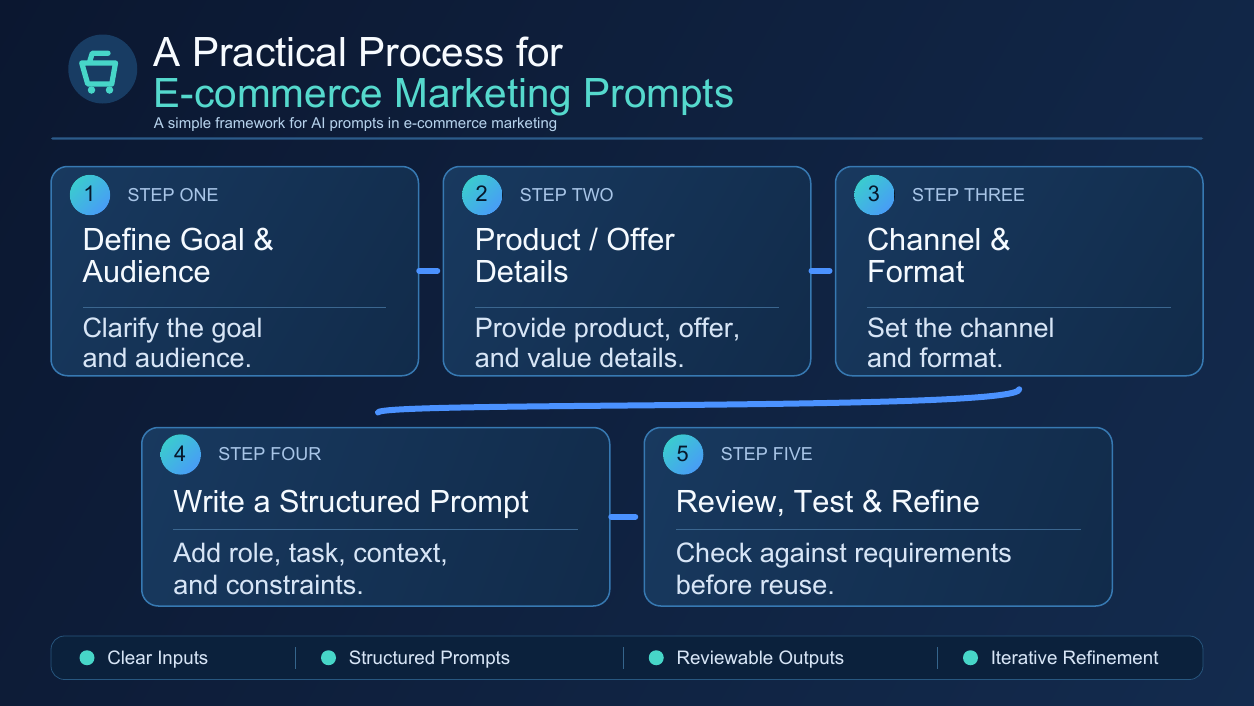
Moving beyond simple “write me an ad” requests, this five-step process helps a team give the AI clear goals, audience context, product details, channel requirements, and constraints. When campaign prompts need to operate as part of a repeatable process, apply the controls in Controlled AI Workflow design: approved inputs, operating rules, human review gates, and output checks.
For growing stores, AI prompts for e-commerce marketing work best when each prompt connects the product, audience, channel, and offer.
The following steps provide a practical framework for prompt engineering in e-commerce, ensuring your marketing copy templates deliver consistent, strategic outcomes.
| Step | Purpose | What to Consider |
|---|---|---|
| 1. Define Your Goal & Audience | Clarify objective and target demographic. | Sales, leads, engagement? New customers, loyal shoppers, specific demographics? |
| 2. Specify Product/Offer Details | Provide verified product, pricing, and genuine campaign conditions. | Product name, USP, verified benefits, actual price/discounts, real stock/deadline conditions. Ground in supplied merchant facts; omit or placeholder unverified claims. |
| 3. Choose Your Channel & Format | Determine the platform and required elements. | Ad, email, social post? Headline, body, CTA, subject line, hashtags? |
| 4. Craft Your Core Prompt | Combine all elements into a comprehensive instruction. | Tone, length, keywords, specific CTA. |
| 5. Refine & Iterate | Review and improve AI output. | Does it hit the mark? How can you make it even better with follow-up prompts? |
1. Define Your Goal & Audience
What are you trying to achieve? Is it direct sales, lead generation, website traffic, or brand engagement? Who are you talking to? Are they new customers, loyal shoppers, or a specific demographic with unique pain points?
2. Specify Product/Offer Details
Clearly articulate what you are selling. What is its unique selling proposition (USP)? List key benefits based on verified features, not invented claims. Include accurate price points and merchant-approved discount terms. If incorporating scarcity or urgency, base it strictly on real, supplied conditions—such as verified low stock counts, an actual campaign end date, or a genuine shipping cutoff—never on fabricated countdowns or false claims. Prompts must be strictly grounded in facts supplied by the merchant: never ask the AI to invent missing offer terms, discounts, customer testimonials, reviews, bestseller rankings, stock levels, cart deadlines, health/efficacy claims, product results, certifications, or performance data. If required information is missing, omit it, use a clearly marked placeholder (e.g., [Offer End Date]), or flag it for confirmation.
3. Choose Your Channel & Format
Is this copy for a Google Ad, a Facebook post, or an email? Each channel has specific requirements and character limits. Detail what specific elements are needed: a headline, body copy, call-to-action (CTA), subject line, or relevant hashtags.
4. Craft Your Core Prompt
Combine all elements from steps 1-3 into a single, comprehensive prompt. Crucially, add instructions regarding tone (e.g., friendly, professional, playful), desired length, specific keywords to include, and precise CTA wording.
5. Refine & Iterate
The AI’s first output is a starting point. Review it critically. Does it resonate? Is it clear? Use follow-up prompts to refine the copy: “Make it shorter,” “Add more urgency,” “Rewrite for Gen Z,” or “Emphasize benefit X.”
Mastering the Fundamentals of E-commerce AI Copywriting
To get valuable output from your AI assistant, you must provide clear, concise, and contextual prompts. This section highlights the difference between ineffective and effective prompting for your marketing copy campaigns.
3.1. The Anatomy of a Well-Structured Prompt: Role, Task, Context, & Constraints
A strong prompt has four core components:
- Role: Assign the AI a persona (e.g., “Act as an experienced e-commerce copywriter”).
- Task: Clearly state what you want the AI to do (e.g., “write three ad headlines”).
- Context: Provide verified details about the product, audience, offer terms, and approved claims. Ground the model strictly in supplied merchant data; never instruct the model to invent unverified facts, discounts, reviews, or performance claims.
- Constraints: Specify tone, length, keywords, formatting, and specific CTAs.
Here’s a basic universal prompt structure template:
[Role] [Task] for [Product/Service] targeting [Audience] with [Key Information] in a [Tone] [Format]. Add [Specific Constraints, e.g., CTA, keywords, length]. Constraint: Use only supplied product facts, verified pricing/terms, and approved claims. Do not invent testimonials, discounts, scarcity, reviews, or performance data; use explicit placeholders for missing details.Real-world examples:
Poor Prompt:
Write an ad for my new shoes.AI Output (likely):
"Step into style with our new shoes! Shop now!"Good Prompt:
Act as a direct-response copywriter for a sustainable fashion brand. Write three Facebook ad headlines and one short body copy for our new "EcoStride" running shoes. These shoes are made from recycled ocean plastics, offer superior comfort and support for daily runners, and are priced at $120. Our target audience is environmentally conscious millennials who prioritize both performance and sustainability. The goal is to drive clicks to the product page. Use an inspiring, action-oriented tone. Include keywords like "sustainable running," "recycled materials," and "eco-friendly." CTA: "Shop EcoStride Now."AI Output (enhanced):
Headlines:
1. Run Greener: EcoStride Shoes Made from Ocean Plastic.
2. Performance Meets Planet: Discover EcoStride Running Shoes.
3. Your Next Stride: Sustainable Comfort for Daily Runs.

Body Copy:
Lace up for a better planet. Our new EcoStride running shoes combine performance with sustainability. Crafted from recycled ocean plastics, they deliver comfort and support for every run. Join the movement: upgrade your gear, protect the Earth. Shop EcoStride Now.
3.2. Crafting Your Brand Voice for AI: Consistency is Key
Your brand voice is your store’s personality. To ensure prompts align, explicitly define your voice in your instructions. Is it friendly, authoritative, playful, or luxurious? Provide examples or descriptive adjectives. Consistency builds trust and recognition.
3.3. Prompt Engineering for E-commerce: From Basic Requests to Strategic Directives
Prompt engineering transforms AI from a simple text generator into a strategic marketing partner. It involves structuring prompts to guide the AI toward specific outcomes. This means moving beyond “write me an email” to “write a personalized abandoned cart email for a customer who viewed the ‘X’ product, offering a 10% discount if they complete their purchase within 24 hours, in a helpful and slightly urgent tone.” For more insights on how to use AI prompts for e-commerce effectively, explore our dedicated resources.
AI Prompts for E-commerce Ads
AI can help draft platform-specific ad copy aligned with campaign objectives such as clicks or conversions. The prompt templates below include example AI outputs to demonstrate structure and tone; these are illustrative examples rather than verified historical campaign results. Review every draft against your actual product, offer, brand guidelines, and live campaign data before use.
Mini-framework: The AIDA Framework for AI Ads
- Attention: Hook the audience with a bold statement or question.
- Interest: Highlight key features or benefits.
- Desire: Paint a picture of the solution or transformation.
- Action: Provide a clear, compelling call-to-action.
4.1. Google Search Ads: Capturing Intent at the Moment of Truth
Google Search Ads target users with high intent, making precise, keyword-rich copy essential. Focus on clarity, direct benefits, and a strong CTA within character limits.
Prompt Templates for Headlines (H1, H2, H3)
-
Prompt: “Act as an SEM copywriter. Generate three unique, keyword-rich Google Ad headlines (max 30 chars each) for our organic, ethically sourced coffee beans. Target ‘organic coffee delivery’ keywords. Focus on convenience and premium taste. Tone: sophisticated. CTA: ‘Shop Now.'”
Example AI Output:
1. Organic Coffee Delivered
2. Premium Ethical Beans
3. Fresh Brew, Your Door
Prompt: “Write two benefit-driven headlines (max 30 chars) for a new line of noise-canceling headphones. Emphasize ‘immersive sound’ and ‘all-day comfort’. Target ‘best noise canceling headphones’. CTA: ‘Discover More’.”
Prompt Templates for Descriptions (D1, D2)
-
Prompt: “Generate two descriptive lines (max 90 chars each) for a Google Ad for custom-made engagement rings. Highlight ‘unique designs,’ ‘ethical diamonds,’ and ‘personalized service’. Tone: luxurious, trustworthy. CTA: ‘Design Your Ring’.”
Example AI Output:
1. Craft Your Dream Ring. Unique Designs, Ethical Diamonds.
2. Personalized Service. Begin Your Journey Today.
Prompt: “Write one problem-solution description (max 90 chars) for [Chair Name] using only the verified ergonomic features supplied here: [Verified Features]. Focus on desk comfort, adjustability, support features, and intended workspace use without claiming pain relief, posture correction, or other health outcomes unless explicitly supplied as approved claims. Keywords: ‘ergonomic chair,’ ‘lumbar support’. CTA: ‘Explore the Chair’.”
Prompt Templates for Call-to-Actions (CTAs)
-
Prompt: “Give me five concise, action-oriented CTAs (max 15 chars) for a flash sale on winter apparel.”
Example AI Output:
1. Shop Sale Now!
2. Grab Your Deals!
3. Save Big Today!
4. Limited Time!
5. Don't Miss Out!
4.2. Facebook/Instagram Ads: Stopping the Scroll & Building Desire
These platforms require engaging copy that captures attention quickly and builds desire. Storytelling and emotional appeal work well here.
Prompt Templates for Engaging Main Copy
-
Prompt: “Act as a lifestyle brand copywriter. Write a 90-word Facebook ad main copy for our new line of sustainably made yoga mats. Focus on promoting relaxation, durability, and eco-friendliness. Target wellness-focused individuals. Tone: calming, inspiring. Include emojis. CTA: ‘Find Your Zen’.”
Example AI Output:
Bring calm to your daily practice with yoga mats designed for lasting durability and mindful living. 🧘♀️ Built to support your routine day after day, our sustainably made mats combine durable design with an eco-friendly commitment you can feel good about. Take a deep breath, unwind, and create space for relaxation. ✨ Find Your Zen today: [Link] Prompt: “Generate a 70-word Instagram ad caption for a gourmet meal kit service. Highlight ‘fresh ingredients,’ ‘easy recipes,’ and ‘stress-free dinners’. Tone: enthusiastic, convenient. Include 3-5 relevant hashtags. CTA: ‘Order Your Kit’.”
Prompt Templates for Benefit-Driven Headlines
-
Prompt: “Create three benefit-driven headlines (max 60 chars) for an Instagram ad promoting a monthly subscription box for pet owners. Focus on ‘delighting your pet’ and ‘curated toys & treats’. Tone: cheerful, loving. CTA: ‘Subscribe Now’.”
Example AI Output:
1. Spoil Your Pet Monthly!
2. Happy Pet, Happy Life!
3. Curated Joy for Your Furry Friend.
Prompt Templates for Storytelling/Problem-Solution Ads
Prompt: “Write a 100-word problem-solution Facebook ad copy for a product that solves common pet odor issues. Start with a relatable problem, introduce the product as the solution, and highlight its unique features (e.g., natural ingredients, long-lasting). Tone: empathetic, trustworthy. CTA: ‘Eliminate Pet Odors’.”
Prompt: “Draft a short, narrative Instagram ad (80 words) for a travel agency promoting a ‘digital detox’ retreat. Describe the stress of modern life and the peace offered by the retreat. Tone: serene, aspirational. Include 3 lifestyle hashtags. CTA: ‘Book Your Escape’.”
4.3. Product Launch Ad Prompts: Creating Hype & Demand
Prompt: “Act as a tech product marketer. Write two short (50-word) Facebook ad copy versions for the pre-order launch of a new smartwatch. Emphasize its ‘health tracking’ and ‘sleek design’. Create urgency for pre-orders. Tone: exciting, visionary. CTA: ‘Pre-Order Yours’.”
Prompt: “Generate three attention-grabbing Instagram ad headlines (max 40 chars) for a new limited-edition sneaker drop. Focus on ‘exclusivity’ and ‘style’. Tone: exciting, exclusive. CTA: ‘Get Notified’.”
Prompt: “Draft a compelling 75-word ad for [Product Name]. Use only the verified hero ingredient and merchant-approved cosmetic benefits supplied here: [Verified Ingredient] [Approved Claims]. Target skincare enthusiasts. Tone: premium and informative. Do not invent clinical evidence, ingredient origins, certifications, visible-result claims, or anti-aging outcomes. CTA: ‘Explore the Formula’.”
4.4. Retargeting Ad Prompts: Nudging Warm Leads to Conversion
Prompt: “Write a 60-word Facebook retargeting ad for users who viewed a specific product (e.g., a ‘Vegan Leather Handbag’) but didn’t purchase. Offer a small incentive (e.g., ‘free shipping’). Remind them of the product’s benefits. Tone: friendly, persuasive. CTA: ‘Complete Your Order’.”
Prompt: “Generate Google Responsive Display Ad text assets for customers who abandoned a cart containing [Product Name]: two short headlines (max 30 chars each), one long headline (max 90 chars), and one description (max 90 chars). Use only supplied product facts and cart context. Do not invent product-quality claims, scarcity, discounts, stock conditions, or deadlines. CTA: ‘Complete Your Order’.”
Example AI Output:
Short Headlines (max 30 chars):
1. Premium Espresso Machine
2. Return to Your Cart

Long Headline (max 90 chars):
Return to your cart for the Premium Espresso Machine and complete your order.

Description (max 90 chars):
Your Premium Espresso Machine is still in your cart. Complete checkout when ready.
Prompt: “Draft a 50-word Instagram Story ad script for retargeting, reminding users of items they’ve browsed [Product Name]. Highlight verified product appeal—use social-proof labels like ‘bestseller’ or ‘top rated’ only if backed by confirmed store sales data or ratings. If an offer deadline or stock limit is active, state the verified condition; otherwise, emphasize product features and customer benefits. Include a visual suggestion (e.g., ‘show product in use’). Tone: engaging, direct. CTA: ‘Complete Your Order’.”
AI Prompts for E-commerce Email Marketing
AI can significantly streamline your email marketing campaigns, from subject lines to full email bodies, supporting your email marketing strategy.
5.1. Subject Line Prompts: The Gateway to Open Rates
A compelling subject line is crucial for open rates. Use AI to brainstorm variations that leverage curiosity, urgency, personalization, or clear benefits.
Prompt Templates for Curiosity-Driven Subject Lines
-
Prompt: “Generate five curiosity-driven subject lines (max 40 chars) for an email announcing a new product line for home decor. Don’t reveal the product directly. Tone: intriguing.”
Example AI Output:
1. Something new is coming... 🤫
2. Your home is about to change.
3. Guess what just arrived?
4. A touch of design for your space.
5. Ready for a decor refresh?
Prompt Templates for Urgency/Scarcity Subject Lines
Prompt: “Write five urgency-driven subject lines (max 50 chars) for an email promoting a 24-hour flash sale on popular electronics. Include emojis. Tone: urgent.”
Prompt Templates for Personalized Subject Lines
-
Prompt: “Create five personalized subject lines (max 50 chars) for a loyal customer named [Customer Name] announcing a special discount on their favorite product category (e.g., ‘running shoes’). Tone: appreciative, exclusive.”
Example AI Output:
1. [Customer Name], a Special Treat Just For You!
2. Your Favorite Running Shoes, Now On Sale!
3. Exclusively for You, [Customer Name]!
4. We Missed You, [Customer Name]! Here's [Discount].
5. An Offer Just For [Customer Name] – Don't Miss It!
Table: Subject Line Prompts for E-commerce
Here’s a starting point for generating a wide variety of subject lines. Simply replace the bracketed information:
| Category | Prompt Idea |
|---|---|
| New Arrivals | New In: [Product Category] You’ll Love! ✨ |
| Just Dropped: [Product Name/Collection] | |
| Discover Your Next Favorite [Product Type] | |
| Sales/Discounts | ⚡ Flash Sale: [Discount]% Off [Product Category] |
| Your [Discount]% OFF Code Expires Soon! | |
| Don’t Miss Out! [Event] Sale Ends Tonight! | |
| [Discount]% Off EVERYTHING! For a Limited Time. | |
| Urgency/Scarcity | Offer Ending: [Offer End Date] Deadline for [Product] |
| Low Stock Update: Only [Verified Stock Level] Left of [Product] | |
| Cart Notice: Reservation Held Until [Actual Cart Deadline] | |
| Curiosity | We’ve Got a Secret for You… 👀 |
| Something Special Just For You (Open Me!) | |
| Did You See This Yet? | |
| Personalization | [Customer Name], We Thought of You! |
| A Special Offer for [Customer Name] | |
| Your Wishlist Is Waiting, [Customer Name] | |
| Benefits/Solutions | Solve Your [Problem] With Our [Product] |
| Achieve [Desired Outcome] Faster | |
| Effortless [Benefit] Starts Here | |
| Engagement | Tell Us What You Think! 🤔 |
| Quick Question for [Customer Name]! | |
| Your Feedback Matters! | |
| Welcome/Onboarding | Welcome to [Your Brand Name]! 🎉 |
| Your Journey Starts Now! | |
| Here’s Your [Discount]% Off First Order! | |
| Abandoned Cart | Did You Forget Something? 🛒 |
| Your Cart is Waiting! | |
| Complete Your Order & Get [Incentive]! | |
| Re-engagement | We Miss You! Here’s a Little Something. |
| Still Looking for [Product Category]? | |
| Don’t Be a Stranger! 👋 |
5.2. Welcome Series Email Prompts: Nurturing New Subscribers
Prompt: “Act as a welcoming brand ambassador. Write the first email in a welcome series for new subscribers who just signed up for our newsletter. Introduce our brand, thank them for joining, and offer a [10% discount] on their first purchase. Keep it warm, friendly, and informative. Include a clear CTA to shop. Subject Line: ‘Welcome to [Brand Name]! Here’s Your [Discount] Off!'”
Prompt: “Generate the second email for a welcome series (approx. 150 words). This email should highlight our brand’s unique story and values (e.g., ‘handmade with love,’ ‘sustainable materials’). Encourage them to explore our ‘About Us’ page and popular product categories. Tone: inspiring, authentic. Subject Line: ‘Our Story, Your Journey’.”
Prompt: “Draft the third email in a welcome series featuring real customer reviews. Use only supplied customer quotes: [Insert Real Customer Testimonials] or explicit placeholders like [REAL CUSTOMER TESTIMONIAL 1]. Do not invent customer names, ratings, or quotes. Reiterate the verified initial discount [Discount Code] if still valid, or reference an approved incentive. Tone: trustworthy, welcoming. Subject Line: ‘See What Our Customers Are Saying About [Product]’.”
5.3. Abandoned Cart Recovery Prompts: Reclaiming Lost Sales
Prompt: “Act as a helpful sales associate. Write an abandoned cart email (approx. 100 words) for a customer who left ‘Product X’ in their cart. Gently remind them of the item, reiterate a key benefit, and offer free shipping as an incentive. Tone: helpful, slightly urgent. CTA: ‘Complete Your Purchase Now’.”
Prompt: “Generate a follow-up abandoned cart email (approx. 80 words) for a customer who has not completed their order. If supported by merchant data, include verified stock status (e.g., [Verified Stock Level] left) or confirmed bestseller status; if unverified, focus strictly on product value and cart convenience without inventing scarcity. Include an approved incentive code [Discount Code] only if authorized. Tone: helpful, value-driven. Subject Line: ‘Still Deciding? Complete Your Order for [Product Name]’.”
Prompt: “Create an abandoned cart email that addresses common objections for a high-value item (e.g., ‘luxury watch’). Focus on reassurance, warranty, and craftsmanship. No discount. Tone: reassuring, premium. CTA: ‘Secure Your Watch’.”
5.4. Promotional & Sales Campaign Prompts: Driving Conversions
Prompt: “Write a full email (approx. 180 words) for a ‘Mid-Season Sale’ on [Apparel Brand]. Announce a [30% off] discount on selected items. Highlight various product categories included in the sale. Use bullet points for key benefits/sections. Tone: exciting, value-driven. Subject Line: ‘🔥 Mid-Season Sale: Up to [30% Off] Your Favorites!'”
Prompt: “Generate an email (approx. 120 words) announcing an approved ‘Buy One Get One Free’ offer on [Product Name]. Clearly explain the offer mechanics and verified terms. Use only approved product attributes from the supplied label [e.g., flavor options, mixability, serving size]—do not invent physiological, performance, or health claims. Tone: energetic, straightforward. Subject Line: ‘Special BOGO Offer: Stock Up on [Product Name]’.”
Prompt: “Draft a short, punchy email (80 words) for a 48-hour flash sale on ‘Smart Home Devices’. Create urgency. Include a countdown timer visual suggestion. Tone: urgent, value-focused. Subject Line: ‘Ticking Clock! ⏰ 48-Hour Smart Home Flash Sale!’.”
5.5. New Product Announcement Prompts: Building Excitement & Early Adoption
Prompt: “Act as a product launch specialist. Write an email (approx. 150 words) announcing the launch of our new ‘Smart Garden System’. Highlight its benefits (e.g., ‘grow fresh herbs indoors,’ ‘automated watering’) and how it solves a common problem (‘lack of space’). Include an early bird discount. Tone: innovative, aspirational. Subject Line: ‘Introducing [Product Name]: Your Indoor Garden Awaits!'”
Prompt: “Generate an email (approx. 100 words) for an exclusive pre-order invitation for our ‘Limited Edition Artisan Jewelry Collection’. Emphasize the craftsmanship, unique designs, and scarcity. Target loyal customers. Tone: exclusive, luxurious. Subject Line: ‘An Exclusive Invitation: Pre-Order Our New Collection’.”
Prompt: “Draft a new product announcement email that teases the product before its full reveal. Focus on a problem it solves or a feeling it evokes, without giving away the product name directly. Build anticipation. Tone: mysterious, exciting. Subject Line: ‘Get Ready to [Benefit]… Something New is Coming!'”
AI Prompts for E-commerce Social Media
AI can help generate a high volume of creative, platform-optimized social media captions written for a specific platform, audience, and offer, a crucial part of e-commerce content generation.
Mini-framework: The Hook-Value-CTA Social Media Framework
- Hook: Grab attention immediately (question, bold statement, emoji).
- Value: Provide benefit, information, or entertainment related to your product.
- CTA: Tell followers what to do next (shop, comment, tag a friend).
6.1. Instagram Prompts: Visually Engaging Captions & Stories
Instagram is all about visuals. Your captions should complement images or videos, adding context, storytelling, and personality.
Prompt Templates for Product Showcase Captions
-
Prompt: “Act as a lifestyle brand copywriter. Write an Instagram caption (max 150 words) for a post showcasing our new ‘Summer Breeze’ dress collection. Describe the fabric (lightweight linen), occasion (beach days, brunches), and feeling (effortless elegance). Include 5 relevant hashtags and 3 emojis. Tone: friendly, lifestyle-oriented. CTA: ‘Shop the Collection’.”
Example AI Output:
Bask in effortless elegance with our new Summer Breeze dress collection! ☀️ Crafted from breathable, lightweight linen, these dresses are made for sun-drenched beach days and lazy brunch afternoons. Feel the freedom, embrace the style. Which one is your favorite? ✨ Shop the Collection via link in bio! #SummerStyle #LinenLove #EffortlessFashion #BeachVibes #NewArrivals Prompt: “Generate an Instagram caption (max 100 words) for a photo of our organic skincare serum. Highlight key ingredients (e.g., ‘Vitamin C, Hyaluronic Acid’) and benefits (e.g., ‘radiant skin,’ ‘hydration’). Tone: informative, quality-focused. Include 4 hashtags and 2 emojis. CTA: ‘Get Your Glow’.”
Prompt Templates for Behind-the-Scenes/Lifestyle Captions
Prompt: “Write a short Instagram caption (max 80 words) for a behind-the-scenes photo of our artisans hand-making jewelry. Focus on craftsmanship, passion, and ethical practices. Tone: authentic, appreciative. Include 4 hashtags and 2 emojis. CTA: ‘Explore Our Story’.”
Prompt: “Create an Instagram caption (max 90 words) for a photo of a customer enjoying our camping gear in a scenic outdoor setting. Emphasize adventure, durability, and connecting with nature. Tone: adventurous, inspiring. Include 5 hashtags. CTA: ‘Plan Your Next Adventure’.”
Prompt Templates for Engagement-Boosting Questions
-
Prompt: “Generate three Instagram captions (max 60 words each) for a post asking followers about their favorite way to use our versatile ‘Multi-Use Balm’. Encourage comments. Tone: friendly, interactive. Include 3 hashtags. CTA: ‘Share Your Tips!'”
Example AI Output:
1. Our Multi-Use Balm: What's your go-to trick? ✨ Share your favorite ways to use it below! #BeautyHack #MultiUse #SkincareTips
2. How do YOU balm? 🤔 Tell us your best tips for our amazing Multi-Use Balm! #BeautyCommunity #YourTips
3. Beyond the basics: What's the most creative way you've used our Multi-Use Balm? Let us know! 👇 #VersatileBeauty
6.2. Facebook Prompts: Community Building & Shareable Content
Prompt: “Act as a community manager. Write a Facebook post (approx. 120 words) celebrating a customer milestone (e.g., ‘10,000 orders’). Thank the community and hint at a future giveaway. Include an engaging question. Tone: grateful, celebratory. CTA: ‘Join Our Community’.”
Prompt: “Generate a Facebook post (approx. 100 words) sharing an interesting fact or tip related to our product niche (e.g., ‘3 benefits of plant-based protein’). Link it back to our plant-based protein powders. Encourage shares and comments. Tone: educational, helpful. CTA: ‘Learn More’.”
Prompt: “Draft a Facebook post (approx. 150 words) announcing a live Q&A session with our founder about sustainable fashion practices. Encourage users to submit questions beforehand. Tone: informative, engaging. CTA: ‘Submit Your Questions’ and ‘RSVP Now’.”
6.3. TikTok/Reels Prompts: Short-Form Video Hooks & Scripts
-
Prompt: “Act as a TikTok content creator. Write a 3-part script (15-second total) for a TikTok/Reels video showcasing our ‘Quick Meal Prep Kits’.
Part 1 (Hook): ‘Tired of cooking after a long day?’ (Show messy kitchen/tired person)
Part 2 (Solution): ‘Meet [Product Name]!’ (Show quick assembly of meal kit)
Part 3 (Benefit/CTA): ‘Delicious dinners in minutes! #MealPrepMadeEasy #FastDinner’. Tone: energetic, problem/solution. Include audio instruction: Use a currently trending audio that matches your product mood and platform guidelines.”
Prompt: “Generate a short 10-second Reels script for a ‘satisfying unboxing’ of our luxury candle. Focus on sensory details (sight of packaging, sound of opening, lighting candle). Tone: calm, aesthetic. Include a visual suggestion for each part. CTA: ‘Experience Serenity’.”
-
Prompt: “Draft a 20-second TikTok script for [Hair Serum Name] using only the verified product details and approved cosmetic claims supplied here: [Verified Details/Approved Claims]. Use before-and-after or testimonial framing only when genuine, documented, merchant-approved material has been supplied; otherwise, do not imply a hair-growth transformation or customer result.
Part 1: Hook: Introduce the product or a relevant hair-care routine without inventing a problem or result.
Part 2: Demonstrate verified product details such as texture, application method, or packaging.
Part 3: Show the completed application or styling step without implying an unsupported growth or health outcome.
Audio: [SELECT CURRENT AUDIO AFTER PLATFORM REVIEW]. Tone: engaging and authentic. CTA: ‘Shop the Hair Serum’.”
6.4. Evergreen Content Prompts: Keeping Your Feed Fresh
Prompt: “Write a ‘Did You Know?’ Facebook post (approx. 100 words) about a lesser-known benefit or origin story of a common product in our store (e.g., ‘the history of olive oil’ for a gourmet food store). Encourage discussion. Tone: educational, engaging. CTA: ‘Share Your Thoughts’.”
Prompt: “Generate an Instagram carousel caption (approx. 120 words for 3 slides) offering ‘3 Quick Tips for [Product Use, e.g., extending the life of your houseplants]’. Each tip should be concise. Tone: helpful, expert. Include 4 hashtags. CTA: ‘Save for Later’.”
Prompt: “Draft a ‘Meet the Team’ Instagram post (approx. 70 words) introducing one of our team members. Share a fun fact about them and their role. Include a friendly photo suggestion. Tone: personal, friendly. CTA: ‘Say Hello!'”
6.5. Hashtag & Emoji Prompts: Maximizing Reach & Tone
-
Prompt: “Generate 10 relevant candidate hashtags for an Instagram post about sustainable activewear to verify against current platform trends. Mix broad, niche, and community hashtags.”
Example AI Output:
#SustainableActivewear #EcoFriendlyFashion #EthicalFashion #WorkoutWear #Activewear #ConsciousConsumer #GymLife #FitnessMotivation #SustainableStyle #GreenWardrobe Prompt: “Provide 5 engaging emojis to use in a social media caption for a new line of cozy winter sweaters. Tone: warm, inviting.”
Prompt: “List 7 hashtags and 3 emojis for a product launch post for a high-tech smart home security camera. Focus on safety and innovation. Tone: reassuring.”
Beyond the Basics: Advanced AI Prompt Strategies for E-commerce Success
To truly master e-commerce copywriting, you need to move beyond single-shot prompt generation. This section explores how to iterate, personalize, and scale AI-generated copy for even better results, addressing content volume and variety pain points.
7.1. Iterative Prompting: Refining and Strengthening AI Output
The first output from AI is rarely the finished draft. Treat AI as a collaborative drafting assistant. Use follow-up prompts to refine, clarify, and strengthen the copy. This refinement loop helps your team move from a rough initial draft to a polished, campaign-ready asset ready for testing.
Examples of Iterative Prompts:
- “Make this shorter by 20 words, while retaining the core message.”
- “Add a stronger sense of urgency to the call-to-action.”
- “Rewrite this paragraph for a more playful, Gen Z-friendly tone.”
- “Incorporate the keyword ‘eco-conscious’ naturally into the second sentence.”
- “Give me three alternative headlines for this ad, focusing on ‘value for money’.”
7.2. Personalization & Segmentation with AI: Tailoring Messages at Scale
AI excels at taking base copy and adapting it for different customer segments. Provide the AI with demographic details, purchase history, or behavioral data, and it can tailor messages at scale.
-
Prompt: “Take the abandoned cart email from earlier. Rewrite it to specifically target a customer segment aged 18-24, using more informal language and focusing on ‘trending’ and ‘fear of missing out’. Keep the offer of free shipping.”
-
Prompt: “Generate 5 variations of a product announcement email subject line. Each variation should target a different customer segment:”
- Loyal customers (emphasize exclusivity)
- First-time buyers (emphasize introductory offer)
- Budget-conscious shoppers (emphasize value)
- Eco-conscious consumers (emphasize sustainability)
- Tech enthusiasts (emphasize innovation)
7.3. A/B Testing AI-Generated Copy: Data-Driven Optimization
AI generates numerous copy variations efficiently. This allows you to A/B test different headlines, body copies, and CTAs across your campaigns. Use the data to understand what resonates best with your audience, continually optimizing for higher conversions. AI assists in providing the variants; your data validates the winners.
7.4. Scaling Your Content Production: Managing AI Workflows
For larger e-commerce operations, AI transforms content production. You can use it to:
- Generate bulk content for product descriptions (e.g., ChatGPT prompts for product descriptions).
- Automate the creation of seasonal campaign copy.
- Adapt existing copy for new markets or languages.
Developing a workflow where AI drafts the initial copy, and human editors refine it, ensures both speed and quality. This B2B implementation streamlines marketing efforts and addresses scalability challenges effectively. When support operations need the same structure, AI agents for e-commerce customer support can connect order data, policies, and escalation paths in a similar workflow.
Conclusion: Your E-commerce Marketing Playbook
Creating effective e-commerce marketing copy no longer requires starting from a blank page every time. By pairing structured AI prompts with clear brand context and verified product facts, you can streamline drafting and explore fresh creative angles across your channels.
This guide provided a practical prompt library and a five-step process designed to anchor your marketing in real constraints. From search and social ads to targeted emails and organic posts, AI serves as an adaptable drafting assistant when guided by accurate inputs and consistent brand voice.
Used consistently, AI prompts for e-commerce marketing turn campaign copy into a repeatable workflow rather than a one-off shortcut.
If you want to connect these campaign prompts to a repeatable operating process, see our guide to AI workflows for e-commerce.
Treat every AI generation as a first draft: verify claims, apply human review, test variations against real campaign data, and iterate. Consistent prompt discipline and thorough review are what turn raw AI output into dependable marketing assets for your store.
Ready to transform your e-commerce marketing with AI?
Don’t just read about it, do it! Download the E-commerce AI Workflow & Prompt System Starter to get ready-to-use prompts for product pages, ads, emails, and workflow planning.
Frequently Asked Questions (FAQ)
1. What are the best AI tools for generating e-commerce marketing copy?
ChatGPT, Gemini, Jasper, Copy.ai, and Writesonic can all be used in e-commerce marketing workflows. ChatGPT and Gemini are general-purpose conversational AI tools, while Jasper, Copy.ai, and Writesonic provide specialized marketing-oriented AI platforms and workflows. Choose a tool based on the specific workflow, integrations, governance requirements, and review process rather than assuming one platform is best for every task.
2. How can I ensure AI-generated copy matches my brand voice and style?
Explicitly define your brand voice in your prompts (e.g., “Act as a playful, eco-conscious brand,” or “Use a sophisticated, minimalist tone”). Provide examples of your existing copy for the AI to emulate. Consistency comes from clear directives in your prompt engineering.
3. Can AI truly write conversion-focused marketing copy that resonates with customers?
AI can draft persuasive copy aligned with your campaign objectives when you provide clear audience context, verified product features, and strict brand guidelines. However, AI cannot guarantee conversions or emotional resonance on its own. Human review is required to verify factual accuracy and brand tone, and only real campaign testing determines how well the copy performs with your customers.
4. Is AI copy unique, or will it be flagged for plagiarism or sounding generic?
Do not assume AI-generated text is automatically unique or publication-ready. Outputs can be generic or resemble existing phrasing. Use specific, verified brand and product context in the prompt, then have a human review the draft for factual accuracy, brand voice, accidental similarity, and originality before publishing.
5. How do I get started with AI prompts if I’m a complete beginner in e-commerce marketing?
Start with the five-step prompt process outlined in this article. Begin with simple prompts for low-stakes content (e.g., social media captions) and gradually move to more complex tasks like email sequences. Experiment, learn from the outputs, and refine your prompts over time.
6. What’s the key difference between a basic AI prompt and a well-structured e-commerce prompt?
A basic prompt is a vague request (for example, “Write an ad for shoes”) that leaves important details unspecified. A well-structured prompt provides source data, merchant constraints, audience context, approved claims, tone, and formatting requirements. This gives the user more control over specificity, consistency, factual grounding, and the structure of the draft before human review and testing.
7. How can AI help with personalizing e-commerce marketing messages for different customer segments?
AI can take a base marketing message and quickly generate variations tailored to different segments. By providing the AI with segment-specific data (e.g., demographics, past purchases, pain points, preferred language), you can prompt it to adjust tone, highlight relevant benefits, and craft CTAs that resonate deeply with each unique audience group, enabling personalization at scale.
Pingback: Ecommerce AI Safety Framework: 4 Steps to Test Workflows Before Going Live
Pingback: AI Workflows for E-commerce: 7 Automations for Small Stores
Pingback: AI Agents for E-commerce Support: Automate Without Losing Trust