
Most e-commerce product descriptions are boring, repetitive, and written without a clear understanding of buyer psychology. If you are looking for the best ChatGPT Prompts for E-commerce Product Descriptions, you are in the right place.When launching a new store or updating product pages, many store owners make the same mistake. They copy dull specifications from the manufacturer, write a few generic lines, or ask ChatGPT for a basic product description without giving it the right direction. The result is usually robotic, forgettable copy that fails to explain why the product matters.
A weak product description does more than make your store look unprofessional. It can reduce conversions, weaken your SEO, and make it harder for buyers to choose your product over a competitor’s. The good news is that ChatGPT can produce far better results when you use the right prompt structure.
New to prompt engineering? Read our complete guide on how to use AI prompts for e-commerce.
In this guide, you will learn how to create ChatGPT prompts that highlight product benefits, match your brand voice, address buyer intent, and include SEO keywords naturally. Whether you sell fashion products, tech gadgets, beauty items, or everyday e-commerce essentials, these 25 ready-to-use prompt examples will help you write clearer, more persuasive product descriptions faster.
Pro Tip: Looking for a ready-to-use workflow and prompt system? Access our free E-commerce AI Workflow & Prompt System Starter to get plug-and-play prompt formulas for product descriptions, ads, emails, and store content.
Table of Contents
- Why most AI product descriptions fail
- What makes a product description clear, persuasive, and useful?
- Create a product brief before using ChatGPT
- The anatomy of a well-structured AI prompt
- 25 ChatGPT prompts for product descriptions
- How to add SEO keywords without stuffing
- Before and after example
- The 5-minute human editing checklist
- Scale faster with a workflow starter
- FAQs
Why Most AI Product Descriptions Fail
When merchants first use ChatGPT for their product pages, the results are often disappointing. The problem is rarely the AI itself. In most cases, the issue is the quality of the instructions it receives. A basic prompt produces a basic result. If you want ChatGPT to write product descriptions that sound persuasive, brand-specific, and useful for buyers, you need to give it the right context first.
Before diving into our list of the best ChatGPT Prompts for E-commerce Product Descriptions, it is important to understand why generic AI outputs happen.
Here is why most AI-generated product descriptions fall flat:
The Generic Tone Trap
Without clear brand guidelines, ChatGPT often defaults to a neutral, overly enthusiastic, and predictable tone. The description may sound polished, but it also sounds like hundreds of other automated product pages online. This is a major problem for e-commerce brands because product copy should not only describe the item. It should also reflect the store’s personality, audience, and positioning.
Weak Product Briefs
AI works best when it has specific information to work with. If you only provide the product name, color, and size, ChatGPT has very little context. As a result, it may fill the gaps with generic claims, vague benefits, or repetitive phrases. A strong product brief gives the AI real material: product features, target audience, use cases, benefits, materials, objections, and brand tone. The same structured product data can also help AI agents for e-commerce customer support answer fit, compatibility, and order-related questions more accurately.
Ignoring Buyer Psychology
Many basic prompts ask ChatGPT to list features, but buyers usually make decisions based on benefits. A feature explains what the product has. A benefit explains why that feature matters to the customer. For example, “10,000mAh battery” is a feature. “Keep your phone charged through a full day of travel without searching for an outlet” is a benefit. Good product descriptions connect product details to real buyer needs.
No Clear SEO Strategy
If you simply ask ChatGPT to “write a product description,” it may ignore your target keywords completely. On the other hand, if you force too many keywords into the prompt, the final description can sound unnatural and difficult to read. Google rewards readability. Unnatural keyword repetition can make the page feel spammy, hurt readability, reduce buyer trust, and perform poorly with readers. Instead, write for the buyer first and insert keywords naturally.
What Makes an E-commerce Product Description Clear, Persuasive, and Useful?
Before you start using ChatGPT prompts, it is important to understand what a persuasive product description actually does. A strong description is not just a paragraph of attractive words. It gives shoppers relevant product information, explains practical benefits, and helps them evaluate whether the product fits their needs. Whether written by a human or generated with AI, useful product copy should include the following elements:
- Benefit-Driven Copy: Copy aligned with shopper intent connects verified product features to practical use. Instead of only saying “10,000mAh battery,” a stronger description can explain why that capacity matters in the intended use case—provided the supporting product information is accurate. This gives the shopper clearer context for the feature.
- Emotional Connection: A good product description speaks to the buyer’s needs, frustrations, and desires. For fashion products, this could mean confidence, comfort, or personal style. For tech products, it could mean convenience, speed, or reliability. For skincare products, it could mean trust, self-care, or visible improvement. The more clearly your copy connects the product to the buyer’s desired outcome, the more persuasive it becomes.
- Trust and Clarity: Shoppers need enough information to evaluate a product confidently. Explain what the product includes, how it works, who it is intended for, and any important limits or conditions. Depending on the product, that may include size, material, compatibility, care instructions, ingredients, shipping details, or what comes in the box.
- A Clear Call-to-Action (CTA): A product description should gently move the reader toward the next step. This does not always mean using aggressive sales language. Sometimes a simple closing line such as “Add it to your daily routine” or “Choose your color and upgrade your setup today” is enough to guide the buyer toward action. The best descriptions feel helpful, not pushy.
Before You Use ChatGPT: Create a Product Brief
To get accurate, persuasive copy, provide ChatGPT with a concise product brief before prompting. A reliable brief separates verified product facts from approved claims and clearly identifies details the model must not infer when information is missing:
| Brief Element | What to Include | Example |
|---|---|---|
| Product Name | Exact name and category | CloudWalk Daily Walking Shoes |
| Verified Product Facts | Objective specifications, materials, dimensions, construction details, and other merchant-verified product information | Dual-density EVA foam midsole, breathable engineered-mesh upper, 10mm heel drop |
| Approved Claims | Merchant-approved benefit or performance claims with appropriate substantiation where required | Approved claim: cushioned support designed for extended standing and walking |
| Target Audience | Primary customer and intended use case | Healthcare workers, retail staff, and active walkers |
| Brand Voice | Tone and editorial guidelines | Practical, supportive, grounded |
| Target Keywords | 2–3 target search terms to place naturally | walking shoes, cushioned footwear |
| Unknown / Do Not Infer | Missing details the model must omit or flag rather than guess | Do not claim medical certification, pain relief, or waterproof protection unless supplied and approved |
The Anatomy of a Well-Structured AI Prompt
An engineered product description prompt follows a specific 5-part formula:
To get the highest quality output from your ChatGPT Prompts for E-commerce Product Descriptions, you must understand the basic anatomy of a well-structured AI instruction.
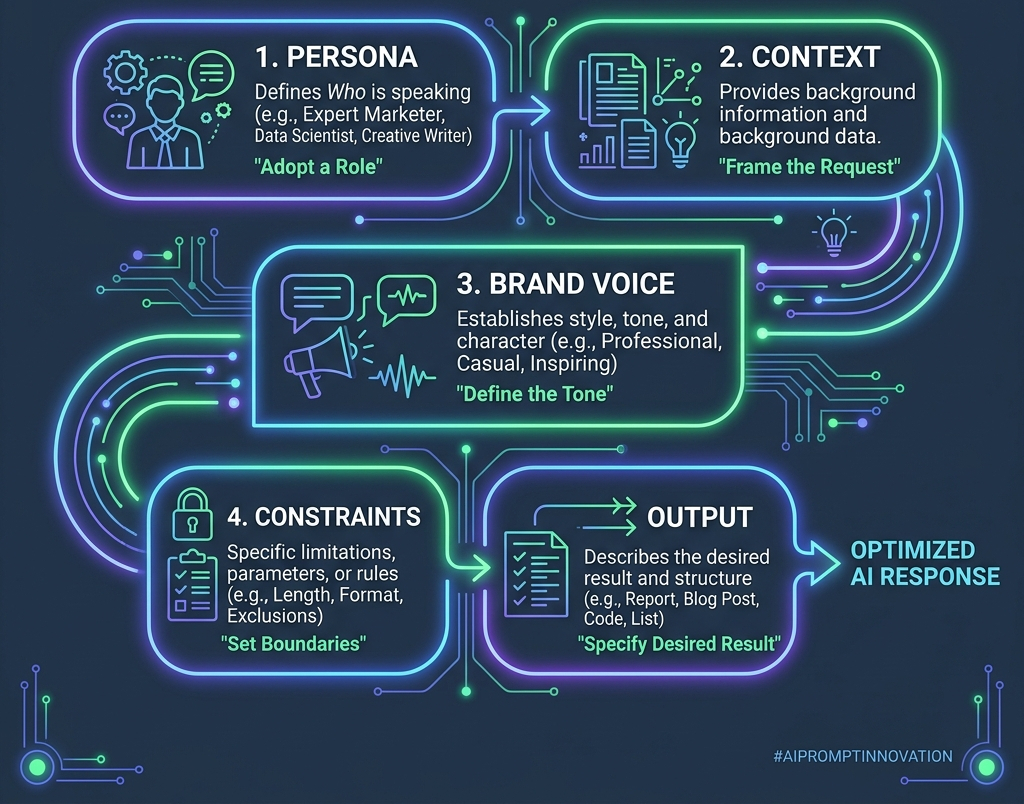
- Persona: Tell the AI who it is (for example, “Act as an expert e-commerce copywriter”).
- Context: Provide the product brief, including verified specifications, audience, materials, and approved claims.
- Brand Voice: Define the style (for example, “conversational, authoritative, no hype”).
- Constraints: Set limits such as word count, banned buzzwords, formatting rules, and claim boundaries.
- Output Structure: Define the layout (for example, “1 hook sentence, 1 short paragraph, 3 bullet points”).
Global Grounding Rule: Across every prompt in this library, use only verified product facts and merchant-approved claims supplied in the brief. If a specification, certification, result, capability, or other claim is missing, omit it or flag the missing information for review rather than guessing. Do not invent product facts or unsupported outcomes.
25 Best ChatGPT Prompts for E-Commerce Product Descriptions
Copy and paste these templates directly into ChatGPT. Just fill in the brackets [ ] with your product details.
Fashion & Apparel
- Casual Wear Prompt: “Act as a fashion copywriter. Write a 100-word product description for [Product Name]. Focus on comfort, daily styling options, and breathable material: [Materials]. Tone: Relaxed and friendly.”
- Athletic Wear Prompt: “Write a benefit-driven description for [Activewear Item]. Highlight performance, moisture-wicking features, and durability during high-intensity workouts. Target audience: [Audience].”
- Formal Wear Prompt: “Draft an elegant product description for [Item Name]. Focus on fit, premium tailoring, and the feel of luxury. Banned words: ‘stunning’, ‘gorgeous’.”
- Footwear Prompt: “Write a product description for [Shoe Name] using the supplied sole, cushioning, fit, and comfort details: [Verified Features]. Tone: Practical and supportive. Include pain-relief or therapeutic claims only if they are explicitly provided in the brief as merchant-approved, substantiated claims.”
- Accessories Prompt: “Write a short, sensory-rich description for [Accessory Name] explaining how it elevates a basic outfit.”
Tech & Electronics
- Gadgets Prompt: “Act as a tech reviewer turned copywriter. Explain how [Product Name] solves the user’s daily frustration of [Problem]. Use simple language, no complex jargon.”
- Smart Home Devices Prompt: “Focus on convenience and security. Describe how [Device Name] integrates into a busy family routine. Word count: 120 words.”
- Computer Accessories Prompt: “Write a product description for [Item Name] using the verified ergonomic features, adjustability, dimensions, and compatibility supplied here: [Features/Specs]. Describe productivity or health-related outcomes only if they are explicitly included as merchant-approved claims.”
- Audio Gear Prompt: “Describe the immersive sound experience of [Headphone/Speaker Name]. Use sensory words to describe bass, noise isolation, and comfort.”
- Wearables Prompt: “Explain the verified tracking functions of [Smartwatch/Tracker Name] using only these supplied features and sensors: [Sensors/Specs]. Describe day-to-day use without turning tracking features into medical, diagnostic, treatment, or health-improvement claims unless those claims are explicitly supplied and approved.”
Beauty & Skincare
- Anti-Aging Cream Prompt: “Write a trust-focused skincare description for [Product Name]. Use the verified active ingredients, texture, application details, and approved cosmetic claims supplied here: [Ingredients/Approved Claims]. Do not invent visible-result claims or timeframes.”
- Organic/Natural Makeup Prompt: “Write a product description for [Product Name] using the supplied shade, finish, ingredients, and approved product claims: [Verified Details]. Mention organic certification, cruelty-free status, or skin-benefit claims only when they are explicitly supplied in the brief. Do not infer certification or status from branding or ingredients.”
- Hair Care Prompt: “Write a description for [Shampoo/Oil Name] using the verified ingredients, texture, scent, application details, and merchant-approved cosmetic benefits supplied here: [Verified Details/Approved Claims]. Tone: Warm and salon-expert. Do not claim repair, restoration, added shine, softness, or other results unless those benefits are included in the approved claims.”
- Perfume/Fragrance Prompt: “Use rich sensory descriptions to paint a picture of the scent profile (Top notes, Heart notes, Base notes) for [Fragrance Name].”
- Serums Prompt: “Write a concise, clear description for [Serum Name] using the verified ingredients, texture, application details, and merchant-approved benefit claims supplied here: [Verified Details/Approved Claims]. Do not invent clinical efficacy, treatment claims, visible results, or outcomes for concerns such as hydration or dark spots.”
Home & Kitchen
- Cookware Prompt: “Write a description for [Pan/Pot Name]. Emphasize even heating, easy cleanup, and how it makes home cooking feel professional.”
- Bedding/Sheets Prompt: “Write a description for [Sheet Name] using the verified material, weave, thread count, hand feel, and any other supplied performance characteristics: [Materials/Specs]. Describe temperature-related or sleep-related benefits only when they are explicitly supplied as approved claims; do not infer better sleep from the product category.”
- Home Organization Prompt: “Show the before-and-after value. Explain how [Product Name] turns a cluttered space into a peaceful, neat room.”
- Furniture Prompt: “Highlight craftsmanship, materials, durability, and how [Furniture Piece] fits into modern home decor.”
- Kitchen Gadgets Prompt: “Explain how [Gadget Name] works using its verified mechanism, operation steps, capacity, and cleanup details: [Features/Specs]. Describe practical workflow advantages from the supplied facts, but use numerical time-saving claims only when the merchant has explicitly supplied and substantiated them.”
Luxury & Premium Goods
- High-End Jewelry Prompt: “Write a refined description for [Item Name] using the verified metal, gemstone, setting, craftsmanship, and provenance details supplied here: [Materials/Craftsmanship]. Mention rarity, historical significance, heritage, or heirloom status only when those claims are explicitly verified in the brief.”
- Premium Leather Goods Prompt: “Describe the patina process, stitching durability, and timeless appeal of [Product Name].”
- Premium Watches Prompt: “Write an authoritative description for [Watch Name] using the verified case material, dimensions, movement specifications, finishing details, and provenance supplied here: [Movement/Specs]. Tone: Restrained and refined. Do not infer precision certifications, accuracy claims, engineering distinctions, or heritage that are not present in the brief.”
- Artisanal Foods Prompt: “Write an appetizing description for [Food Item] using the verified ingredients, flavor notes, serving suggestions, sourcing details, and production methods supplied here: [Verified Details]. Do not invent regional sourcing, small-batch production, producer history, or other provenance.”
- High-End Decor Prompt: “Write a description that positions [Item Name] as a statement piece in a luxury designer home.”
How to Add SEO Keywords Without Keyword Stuffing
Google rewards readability. Unnatural keyword repetition can make the page feel spammy, hurt readability, reduce buyer trust, and perform poorly with readers. Instead, use the natural SEO method:
- Primary Keyword in Header: Place your main search phrase naturally in a subheading.
- Use Synonyms: Instead of repeating your target keyword multiple times, use relevant variations to keep the copy engaging.
- Contextual Placement: Insert keywords in sentences that explain features: “Our orthopedic running shoes feature a custom memory foam sole for ultimate arch support.”
Before and After Example: From Generic AI to Grounded Product Copy
Consider this hypothetical teaching example. For this exercise, the merchant has supplied and verified only four product facts:
- Product Name: SmartPro Watch
- Feature 1: Heart-rate monitor
- Feature 2: Sleep tracker
- Battery: 7-day battery life
These are hypothetical teaching facts, not claims about a real product.
Before (Typical Generic AI Output)
“Introducing the SmartPro Watch. It has a heart rate monitor and a sleep tracker. The battery lasts 7 days. It is a gamechanger for your fitness goals. Buy it now!”
After (Grounded, Precision Output)
SmartPro Watch: Heart-Rate and Sleep Tracking with 7-Day Battery Life
The SmartPro Watch combines a heart-rate monitor, sleep tracker, and 7-day battery life in one wearable device.
- Heart-Rate Monitor: Use the built-in heart-rate monitoring feature.
- Sleep Tracker: Track sleep using the watch’s built-in sleep-tracking feature.
- 7-Day Battery Life: The supplied product information specifies a battery life of seven days.
Three supplied features, presented clearly without adding unsupported specifications.
Factual Verification Note: This rewrite does not add water resistance, charging speed, notifications, health improvements, certifications, or other features that were absent from the hypothetical brief. The goal is not to make the model sound more certain; it is to make the copy more useful while staying within the supplied product facts.
Bonus: Product Descriptions and Structured Data
To stand out in Google Search results, ensure your product description page includes Schema Markup (Structured Data). This can help eligible product pages show richer details in Google Search, such as price, availability, and reviews. You do not always need to manually code this if you use Shopify, WooCommerce, or an SEO plugin. Just make sure your product title, price, availability, reviews, and description are complete.
{
  "@context": "https://schema.org/",
  "@type": "Product",
  "name": "SmartPro Watch",
  "description": "High-performance smartwatch featuring heart rate monitoring, sleep tracking, and 7-day battery life.",
  "offers": {
    "@type": "Offer",
    "priceCurrency": "USD",
    "price": "149.00",
    "availability": "https://schema.org/InStock"
  }
}
The 5-Minute Human Editing Checklist
Before publishing an AI-generated product description, perform this factual and editorial review:
- Verify Specifications & Functionality: Confirm that dimensions, materials, colors, compatibility, technical specifications, and described capabilities match the actual product information.
- Audit Claims & Outcomes: Check health, cosmetic, durability, and performance claims, including numerical or time-bound outcomes, against the merchant’s approved evidence.
- Check Certifications & Provenance: Confirm certifications, ratings, sourcing, manufacturing claims, and provenance against real documentation or verified merchant records.
- Review Guarantees & Comparisons: Remove unsupported guarantees, absolute promises, and unsubstantiated superiority or competitor comparisons.
- Remove AI Clichés: Search for repetitive wording such as delve, unlock, revolutionize, game-changer, cutting-edge, seamless, and elevate.
- Check Readability & Tone: Read the description for clarity and confirm that the voice matches your brand guidelines.
Scale Faster with the E-Commerce AI Workflow & Prompt System Starter
Writing prompts one by one is slow. If you want to scale your operations, you need a complete prompt system. Our E-commerce AI Workflow & Prompt System Starter gives you a free, ready-to-use workflow and prompt system designed to support your product pages, social media ads, customer emails, and landing page copy. Save hours of writing and get professional, sales-ready outputs faster.
For a broader system that connects product copy, marketing, support, reviews, and reporting, read our guide to reusable AI workflows for e-commerce.
If you want these prompts tailored to your products, audience, tone, and review process, explore our custom prompt systems.
FAQs
1. Can I use AI-generated product descriptions for SEO?
Yes, but they should be accurate, original, helpful, and edited by a human before publishing. The goal is not to publish raw AI text, but to use AI as a writing assistant.
2. How long should an e-commerce product description be?
For simple items, 75 to 150 words is perfect. For high-ticket or complex items, 200 to 400 words (including bullet points) helps answer customer objections.
3. Which AI model is best for writing product descriptions?
Advanced AI models such as ChatGPT, Gemini, or Claude can all write strong product descriptions when given a detailed product brief and clear instructions.
4. What is the biggest mistake when using ChatGPT for e-commerce?
Leaving the prompt too generic. Without product details (features, materials, audience), the AI is forced to guess, resulting in generic text.
5. What does prompt engineering improve in product descriptions?
Prompt engineering gives you more control over the output by defining source data, constraints, tone, and structure. This can improve specificity, consistency, factual grounding, product relevance, and readability while reducing the risk of generic or unsupported output.
6. Should I include keywords in my AI prompts?
Yes. You should explicitly list your target SEO keywords in the prompt instructions and ask the AI to write them into the copy naturally.
Conclusion
Structured product briefs and grounded ChatGPT prompts can make product-description drafting more consistent and easier to review. Use verified product facts, clearly separate approved claims from unknown information, and apply human review before publishing. The workflow in this guide gives you a reusable way to create product copy that stays aligned with the available product data and your brand voice. Start with one product, run the draft through the editing checklist, and use the same standard across the rest of your catalog.
Pingback: Ecommerce AI Safety Framework: 4 Steps to Test Workflows Before Going Live