
1. Direct Answer: How to Train ChatGPT on Your Brand Voice
Adjectives such as “warm, witty, yet professional” are useful starting signals, but they are usually too interpretive to keep brand output consistent across tasks, people, and channels.
A more reliable process is:
- Collect representative, editorially approved writing samples.
- Ask ChatGPT to analyze those samples for recurring tone, vocabulary, sentence patterns, formatting habits, claims posture, and contradictions.
- Turn that analysis into a human-approved Voice Spec with observable rules, not just personality adjectives.
- Add approved examples and anti-examples so the acceptance boundary is visible.
- Load the Voice Spec into the right ChatGPT context—usually a Project for brand-specific work, Custom Instructions for broad recurring preferences, or a reusable prompt/Plugin/Skill where appropriate.
- Run a fixed calibration set across the content types you actually publish and revise the spec when outputs fail.
- Spot-review live outputs and re-run the full calibration battery after material changes to the model, tool, Voice Spec, source examples, audience, or workflow.
That is what this guide means by “training ChatGPT on your brand voice”: building a reusable, testable configuration around your existing brand standards—not finding a single magic prompt.
Table of Contents
- 2. What “Training ChatGPT on Your Brand Voice” Actually Means
- 3. Start with Representative Writing Samples
- 4. Convert Writing Samples into Observable Voice Rules
- 5. Build the PPF Voice Spec
- 6. Add Examples and Anti-Examples
- 7. Turn the Voice Spec into Reusable ChatGPT Instructions
- 8. Run the PPF 5-Task Voice Calibration Test
- 9. Diagnose Common Failure Modes
- 10. Store and Reuse the System Across Workflows
- 11. Prevent Brand-Voice Drift with Ongoing Review and Trigger-Based Regression Checks
- 12. Worked E-Commerce Example: “Ridge & Valley Goods”
- 13. Copyable PPF Brand Voice System Template
- 14. Frequently Asked Questions
- 15. Next Steps
2. What “Training ChatGPT on Your Brand Voice” Actually Means
In this guide, “training ChatGPT on your brand voice” means configuring ChatGPT with reusable instructions, reference material, examples, and review criteria. It does not mean fine-tuning an OpenAI model.
OpenAI’s model-optimization guidance treats fine-tuning as a developer/API workflow and lists tone and style among possible fine-tuning use cases. The same guidance places prompt engineering and evals in the optimization workflow before or alongside fine-tuning. This article focuses on the configuration path available inside normal ChatGPT workflows.
For brand-voice work, the configuration can include:
- Persistent instructions: Explicit rules for tone, structure, vocabulary, and boundaries.
- Contextual references: Approved style guides, glossaries, positioning notes, and brand background.
- Reference examples: Approved examples plus rejected examples that show the boundary.
- Negative constraints: Brand-specific phrases, patterns, claims, or structures to avoid.
- Review criteria: Defined checks that determine whether a draft is acceptable.
OpenAI’s prompt-engineering guidance recommends clear, specific prompts, enough context, and descriptive tone adjectives. For a reusable brand system, those adjectives are a starting point rather than the finished specification: the rest of this guide translates them into rules that a reviewer can inspect and test.
3. Start with Representative Writing Samples
Every voice system begins with source material. However, importing an unvetted archive of old company documents can introduce competing styles into your guidelines.
| Prefer as source material | Review carefully or exclude from the baseline |
|---|---|
| Editorially approved content | Outdated legacy copy |
| Signature newsletters | Mixed agency drafts |
| Approved customer messaging | Legal and compliance text |
| Founder or brand essays | Hyper-promotional campaign copy |
Potential Risks in Source Material
- Outdated legacy content: Brands evolve. Copy written several years ago under an earlier editorial strategy may conflict with your current tone.
- Mixed agency or freelance drafts: If multiple writers worked without an enforced style guide, their outputs will reflect competing sentence structures and vocabularies.
- Legal and compliance boilerplate: Terms of service, privacy policies, and regulatory disclaimers rely on rigid terminology that does not represent your editorial voice.
- Hyper-promotional campaign copy: High-urgency promotional blasts (“HURRY! LIMITED TIME ONLY!”) rarely match a brand’s standard conversational baseline.
- Unreviewed drafts: Raw notes or unedited submissions that never underwent editorial approval should not form your baseline.
How to Select Source Material
PPF recommends starting with a deliberately reviewed set rather than importing an entire archive, because it is easier to identify conflicting styles before they enter the Voice Spec:
- Keep the set small enough to review deliberately: Read each piece closely to identify recurring stylistic traits.
- Include enough representative material to expose stable patterns: Select samples across your primary communication formats (such as an educational article, a customer email, and a product overview).
- Prioritize editorially approved examples over raw quantity: Vetted samples make it easier to isolate consistent editorial guidelines.
- Expand the set only when necessary: Add further material only if an essential channel modifier or specific behavioral trait is absent from your initial collection.
Do not exclude past writing merely because it did not achieve specific conversion metrics; conversion performance and editorial voice quality are distinct considerations. Your goal is identifying representative editorial quality.
4. Convert Writing Samples into Observable Voice Rules
Broad adjectives are useful labels, but they are not precise enough to serve as the whole specification. Bold, approachable, authoritative, or witty can be interpreted in several ways.
First, Let ChatGPT Draft the Analysis
After you curate representative samples, you can use ChatGPT to produce a draft voice analysis for human review. The model is helping you inspect the evidence; it is not deciding the final brand standard.
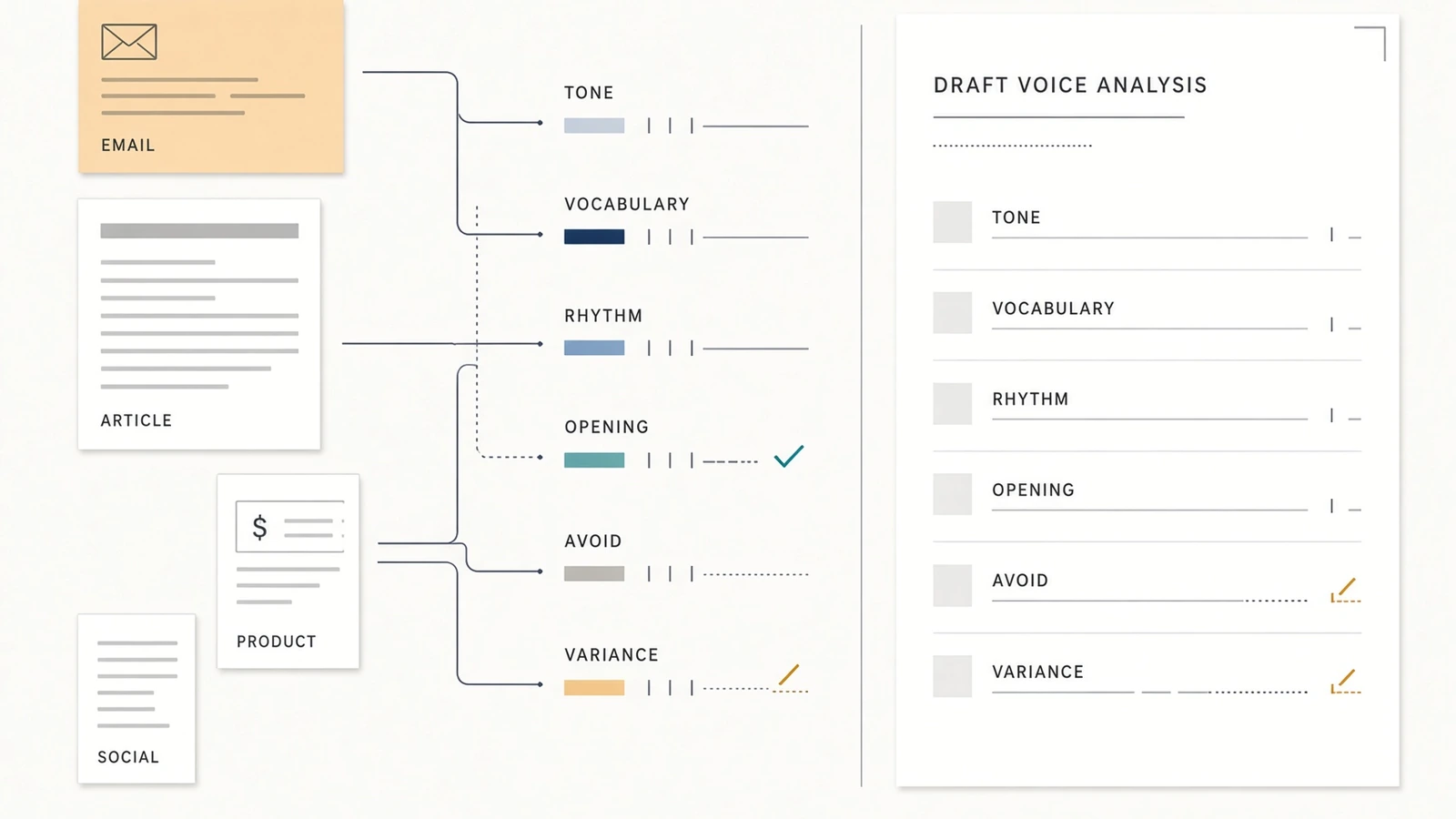
Copy this prompt and attach or paste the approved samples:
Analyze the writing samples below to propose a draft brand-voice specification.

Do not rewrite the samples and do not invent traits that are not supported by them.

For each recurring pattern, report:
1. Tone or stance, with evidence from the samples.
2. Observable sentence and paragraph patterns.
3. Recurring vocabulary, terminology, and phrases.
4. Typical opening and closing behavior.
5. Formatting or structural habits.
6. How claims, evidence, uncertainty, and limitations are handled.
7. Candidate phrases or structures the brand should avoid.
8. Any contradictions between samples.

Then propose a draft set of voice rules.
Separate strong patterns from weak or uncertain patterns.
Flag every rule that needs human editorial judgment before adoption.
Treat the output as an analysis draft. An editor should approve, reject, or rewrite each proposed rule before it enters the canonical Voice Spec.
The Dimension Baseline
A useful starting framework for broad tonal posture is the Nielsen Norman Group’s Four Dimensions of Tone of Voice:
- Formal vs. Casual
- Serious vs. Funny
- Respectful vs. Irreverent
- Matter-of-Fact vs. Enthusiastic
NN/g also discusses specific tone words and “anti-tone” words. PPF uses those broad labels as orientation, then translates them into observable writing behavior.
Translating Subjective Traits into Observable Behaviors
The table below shows illustrative failure patterns and possible rules. These are examples, not universal mandates:
| Subjective Trait | Possible Misreading | Observable Rule Example |
|---|---|---|
| Conversational | The draft becomes overly slangy or opens with forced rhetorical questions. | Use standard contractions and address the reader directly, but avoid rhetorical openers. |
| Authoritative | The draft becomes dense, passive, or jargon-heavy. | State recommendations directly, explain mechanisms, and support factual claims with appropriate evidence. |
| Empathetic | The draft becomes sentimental or patronizing. | Acknowledge the reader’s practical obstacle in concrete terms and move quickly to the useful action. |
| Confident | The draft adds hype, exclamation marks, or unsupported superlatives. | State outcomes plainly, disclose limitations, and do not turn uncertainty into certainty. |
| Direct | The draft removes so much context that it becomes abrupt. | Put the core point early, then include the context needed to act on it. |
The goal is not to make ChatGPT “obey a personality.” It is to create standards that a human reviewer can check in the output.
5. Build the PPF Voice Spec
The PPF Voice Spec is the canonical document that turns your editorial standards into reusable instructions and review criteria. Store one approved master version, then distribute controlled copies into the ChatGPT contexts or production workflows that need it.
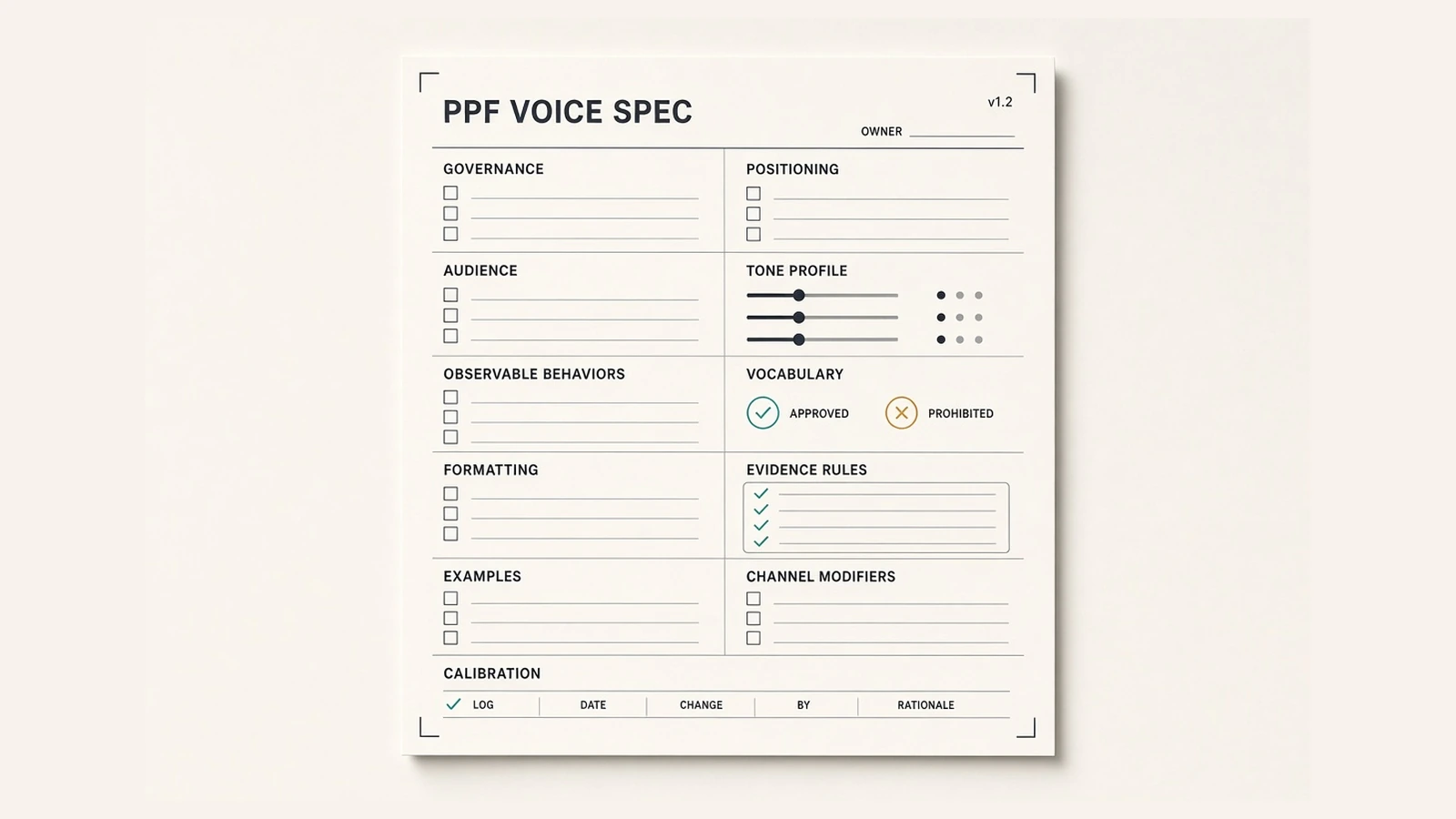
A complete PPF Voice Spec uses the same 11 fields throughout this guide:
- Governance: Version, owner, last reviewed date, and change notes.
- Core Positioning & Communication Objective: What the brand is trying to communicate and what the reader should understand or do.
- Audience & Knowledge Level: Who the content is for and what you can assume they already know.
- Tone Architecture: Broad tone dimensions, specific tone words, and anti-tone words.
- Observable Writing Behaviors: Sentence rhythm, paragraph structure, point of view, openers, conclusions, and other inspectable patterns.
- Vocabulary & Phrasing: Approved terminology plus brand-specific prohibited words, clichés, and constructions.
- Formatting & Layout Tendencies: Heading, list, emphasis, paragraph, and channel-format conventions.
- Claims, Evidence & Accuracy Boundaries: How factual claims, uncertainty, limitations, and sources should be handled.
- Approved Examples & Anti-Examples: Contrast pairs with an explanation of why each passes or fails.
- Channel Modifiers: Only where email, social, documentation, support, or other channels genuinely require different execution rules.
- Calibration & Change Log: What was tested, in which environment, the result, and what changed afterward.
When the master spec changes, update the version and re-upload or replace any copies stored in Projects, Plugins, Skills, prompt libraries, or other workflow systems. The canonical document remains the source of truth.
For a broader control model, see Controlled AI Workflow.
6. Add Examples and Anti-Examples
Rules tell the model what to do; examples make abstract rules concrete by showing what an acceptable output looks like. Anti-examples make the rejection boundary explicit.
To establish clear operational boundaries, pair approved examples with anti-examples that demonstrate unacceptable phrasing, accompanied by a brief explanation of what violated the spec.
Rejected anti-example
“In today’s fast-paced digital world, unlocking your team’s true potential is more critical than ever. Our revolutionary platform empowers you to seamlessly streamline workflows and supercharge productivity.”
Why it fails: It uses throat-clearing, generic corporate phrasing, and unsupported hype.
Approved example
“Manual handoffs between project boards delay release cycles and create blind spots. FlowKit automates ticket status updates between GitHub and Jira so engineering teams keep pull requests moving.”
Why it works: It identifies the friction point, states the mechanism plainly, and names the integration without promotional filler.
Include contrast pairs for the communication formats where voice errors matter most, such as:
- Value proposition or product overview
- Customer service or onboarding message
- Explanatory or educational insight
7. Turn the Voice Spec into Reusable ChatGPT Instructions
Keep the implementation method-first: the Voice Spec is the source of truth; ChatGPT features are delivery mechanisms.
Reusable Configuration Methods
| Method | Best fit | Important constraint |
|---|---|---|
| Projects | Brand-, client-, or publication-specific work | Project instructions apply inside the Project and override global Custom Instructions. Keep the current Voice Spec file in the Project and replace it when the canonical version changes. |
| Custom Instructions | Broad preferences you genuinely want across chats | They apply across chats, so a client-specific Voice Spec can leak into unrelated work. Free/Go users can save up to 1,500 characters; Plus, Pro, Enterprise, Business, and Education users can save up to 5,000 characters. |
| Plugins / Skills | Reusable team workflows where available | As of October 2026, OpenAI is retiring custom GPTs and recommends migrating reusable GPT workflows toward Plugins. Eligible Business, Enterprise, Healthcare, and Edu workspaces can also use Skills to package reusable instructions, examples, and supporting resources. Availability depends on account and workspace settings. |
| Modular task prompt | Portable workflows, APIs, or teams using multiple tools | Insert a condensed Voice Spec or an authoritative reference to it directly into the task prompt. |
Method 1: Projects in ChatGPT
OpenAI’s Projects documentation says Projects keep related chats, files, and instructions together. For brand-specific work, a Project is usually the cleanest home for the full Voice Spec because project instructions apply only inside that Project and override global Custom Instructions.
Recommended setup:
- Create one Project for the brand or publication.
- Add the current Voice Spec as a Project file or source.
- Add short project instructions telling ChatGPT to use that spec as the brand authority.
- Use project-only memory where available if you want the Project isolated from outside conversation context.
- When the canonical Voice Spec changes, replace or re-upload the Project copy and note the new version.
Method 2: ChatGPT Custom Instructions
OpenAI’s Custom Instructions documentation says Custom Instructions are applied across chats.
- Web/Desktop: Settings → Personalization → Custom Instructions.
- iOS/Android: Settings → Customize ChatGPT.
- Scope: Use them for high-level rules you want broadly, not a large client-specific spec.
- Length: Up to 1,500 characters on Free/Go and 5,000 characters on Plus, Pro, Enterprise, Business, and Education plans.
Because Project instructions override global Custom Instructions, avoid duplicating conflicting voice rules in both places.
Method 3: Plugins, Skills, and the Custom GPT Transition
As of October 2026, OpenAI says custom GPTs are scheduled to retire on December 11, 2026 for the standard transition timeline, and recommends migrating reusable GPT workflows to Plugins where available. Do not build a new long-term brand-voice system around a Custom GPT without accounting for that transition.
For eligible Business, Enterprise, Healthcare, and Edu users, Skills in ChatGPT can package reusable instructions, examples, code, and supporting resources for repeatable workflows. A brand Voice Spec can therefore become part of a controlled Skill where workspace policy allows it.
Method 4: In-Prompt Context Injection
For portable workflows, include the required brand context directly in the task prompt:
BRAND VOICE SPECIFICATION
You are writing on behalf of [Brand Name].
Follow the approved Voice Spec below.

<voice_spec>
[INSERT CONDENSED PPF VOICE SPEC OR AUTHORITATIVE EXCERPT]
</voice_spec>

TASK
Draft an introductory customer email announcing our new billing portal.

REVIEW
Check the draft against the applicable Voice Spec rules before returning it.
8. Run the PPF 5-Task Voice Calibration Test
Do not deploy a brand-voice setup based on one output that happens to look good.
In its November 2025 primer How Evals Drive the Next Chapter of AI for Businesses, OpenAI describes evaluation as an ongoing process: define success, test against representative real-world inputs, inspect errors, and continue measuring real outputs after launch.
The PPF 5-Task Voice Calibration Test adapts those general principles to brand voice. It is a PPF operational framework, not an OpenAI standard.
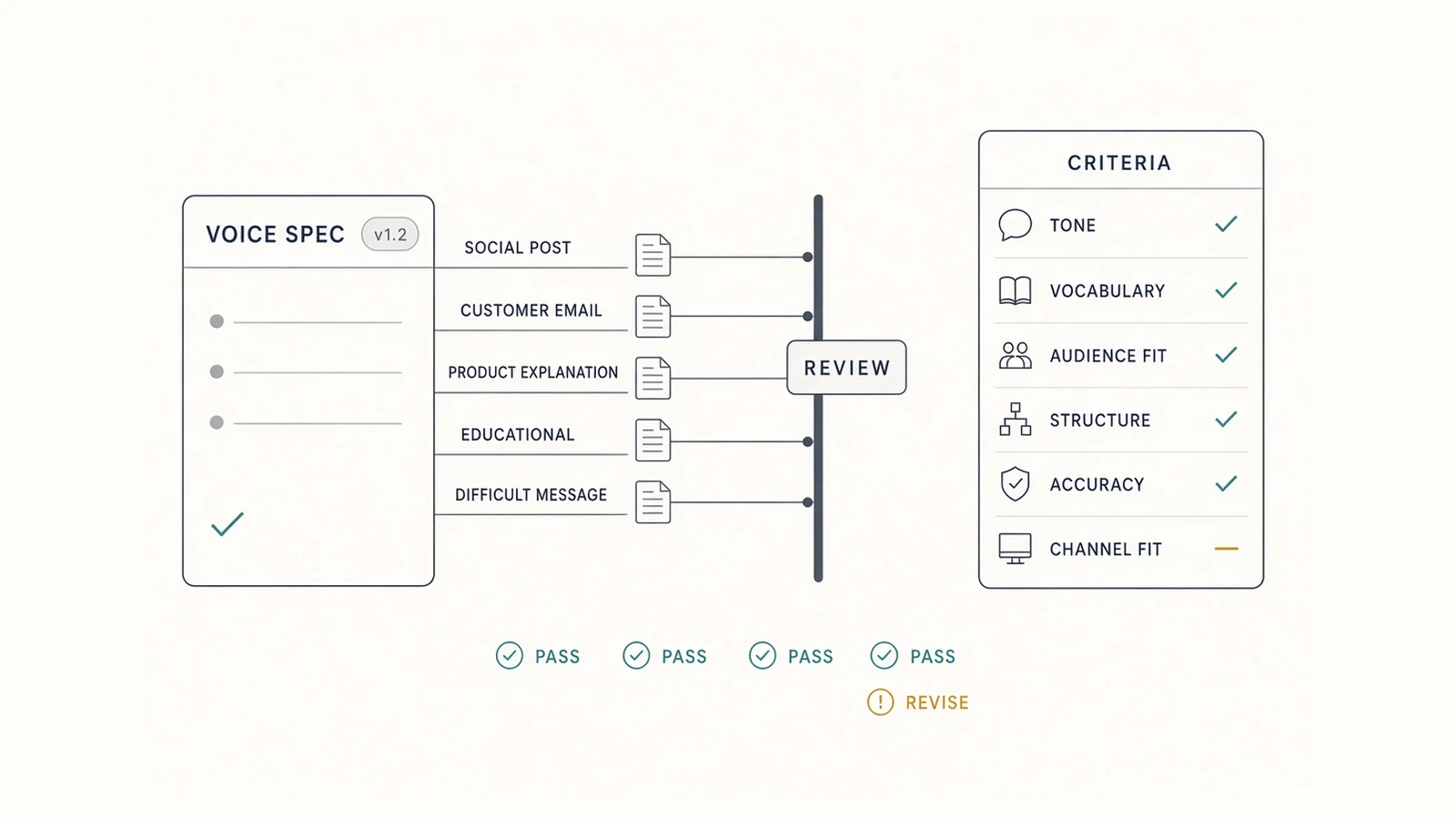
| Task | Fixed scenario | Primary review focus |
|---|---|---|
| 1. Short social post | Write a short update sharing one actionable tip on one fixed social platform. | Cadence, hook discipline, platform fit, formatting restraint. |
| 2. Customer email | Write an onboarding email for a new customer. | Warmth without filler, clear next step, respect for the reader’s time. |
| 3. Product or service explanation | Explain the core offering to a non-technical buyer. | Clarity, audience fit, factual boundaries, absence of hype. |
| 4. Educational passage | Explain a common industry mistake. | Direct thesis, logical development, no throat-clearing. |
| 5. Difficult or corrective message | Notify a customer of a service delay caused by your system. | Professionalism, operational clarity, accountability, controlled tone. |
Keep the task inputs stable across calibration runs so you can compare behavior after a change.
The Calibration Rubric
Review each output against the criteria that apply to that task:
- Tone behavior: Does the draft stay within the approved tone boundaries?
- Vocabulary compliance: Are prohibited phrases and constructions absent?
- Sentence and paragraph behavior: Does the draft follow the spec’s observable structural rules?
- Audience alignment: Does it match the reader’s knowledge level and needs?
- Channel fit: Does the format suit the channel without changing the core voice?
- Structural discipline: Does it get to the point in the way the spec requires?
- Factual integrity: Are facts, uncertainty, and limitations handled correctly?
- CTA posture: If a CTA is required, does it follow the brand’s CTA rules? Mark this Not Applicable when no action is required.
The PPF Acceptance Rule
A task passes when:
- no critical factual or evidence boundary is violated;
- no prohibited brand rule is violated; and
- every review criterion applicable to that task is satisfied.
Because model output can vary, PPF recommends repeating calibration runs—especially for high-risk formats or borderline results—rather than treating one successful generation as proof of stability. There is no universal number of runs; choose the depth based on risk and repeatability.
Keep the Test Environment Deliberate
Use the same environment you intend to deploy.
- For a Project-based system, test inside that Project. Project-only memory can help isolate the brand workspace where available.
- For a Custom Instructions setup, test in a fresh normal chat with the same personalization settings you expect in routine use.
- For a prompt-only baseline that should exclude memory, Custom Instructions, and Plugins, an unpersonalized Temporary Chat provides a cleaner comparison environment.
If a task fails, use the diagnostic matrix below before changing the prompt or Voice Spec.
9. Diagnose Common Failure Modes
When an output fails calibration, use the symptoms below as diagnostic hypotheses. More than one issue may be contributing.
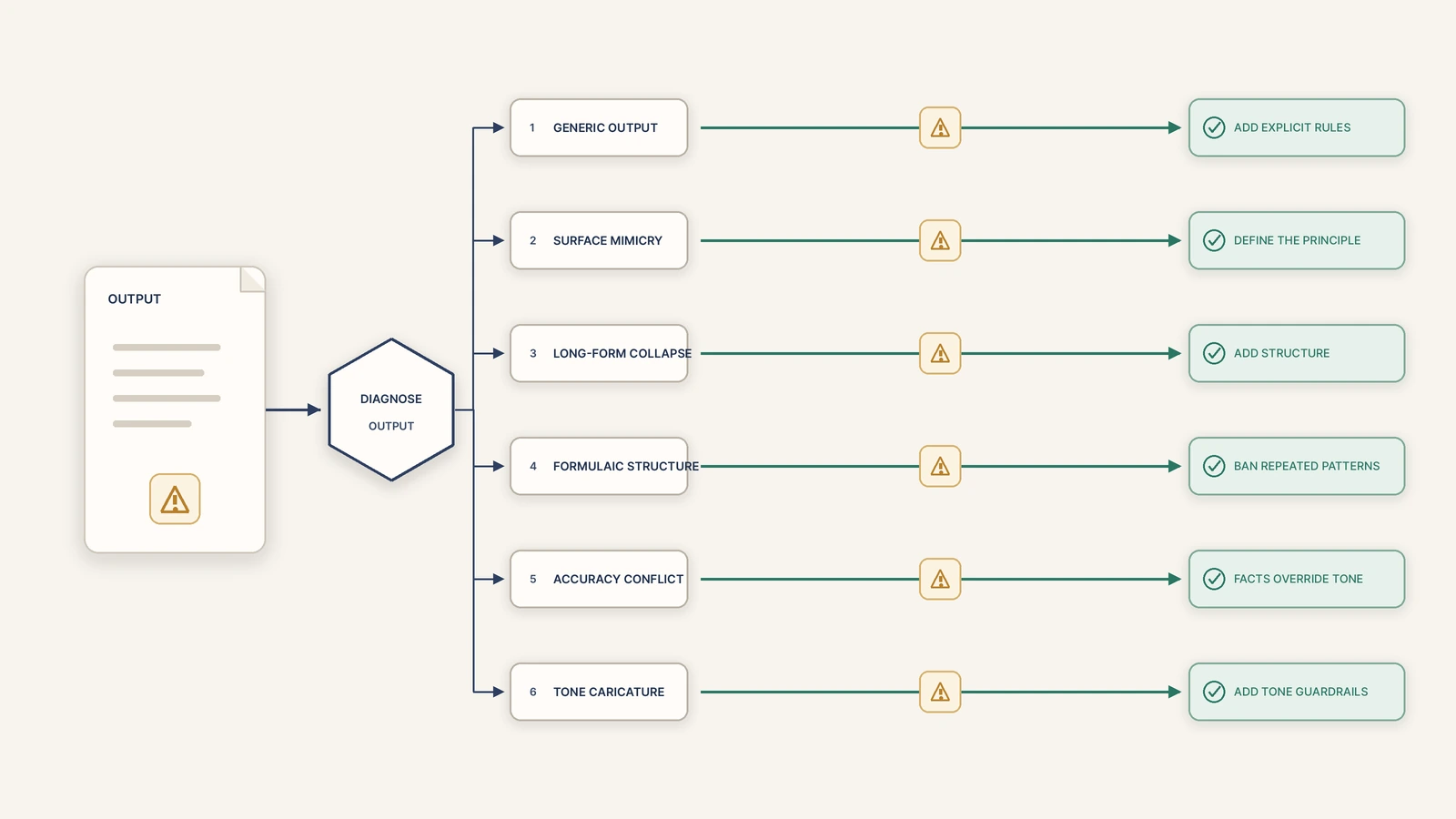
1. The Output Sounds Generic Despite Detailed Instructions
- Symptom: The copy reads like standard corporate filler. It is grammatically correct, but lacks distinct identity.
- Likely Cause: Instructions rely on descriptive adjectives rather than explicit, negative, or syntactic rules.
- The Fix: Add negative constraints and structural rules. Specify what the model should avoid (e.g., prohibiting specific transition phrases or rhetorical questions).
2. Surface Mimicry Without Substance
- Symptom: ChatGPT copies specific phrases or metaphors directly from your few-shot examples instead of adopting the underlying style.
- Likely Cause: The prompt presents examples without explaining the general principles they illustrate.
- The Fix: In your Voice Spec, explicitly state: “Adopt the sentence structure, tone, and pacing of the approved examples. Do not reuse their specific metaphors, topics, or phrasing unless instructed.”
3. Voice Holds in Short Copy but Collapses in Long Form
- Symptom: Social updates and short emails sound natural, but longer articles regress into formulaic essays ending with cliché summaries (“In conclusion…”).
- Likely Cause: Extended drafting lacks section-level structural constraints.
- The Fix: Add long-form structural constraints: “Do not write summary concluding paragraphs. Conclude articles with an immediate tactical step or observation. Avoid any specific transition patterns that your Voice Spec explicitly rejects.”
4. Banned Words Disappear, but Clichéd Structures Remain
- Symptom: ChatGPT avoids banned words like “delve” or “seamless”, but continues generating predictable parallel constructions (“Whether you’re an X or a Y, Z matters”).
- Likely Cause: Blacklisting individual words cleans vocabulary, but leaves sentence architecture unconstrained.
- The Fix: Ban formulaic sentence templates directly. For example: “Avoid the ‘Whether you’re [X] or [Y]’ opener, three-part adjective slogans, and participial openers when those patterns conflict with our brand style.”
5. Facts and Accuracy Distorted to Serve Tone
- Symptom: In an effort to sound bold or punchy, the model exaggerates metrics or makes absolute promises that misrepresent the product.
- Likely Cause: Tone instructions are prioritized over factual boundaries, or boundaries are not clearly defined.
- The Fix: Add an explicit priority directive: “Accuracy and technical precision always override tone. If stating a fact accurately requires a longer sentence, prioritize accuracy over brevity. Never convert a conditional possibility into an absolute guarantee.”
6. The Tone Becomes an Unusable Caricature
- Symptom: The output sounds like an exaggerated parody of your voice (e.g., excessively informal, aggressive, or sarcastic).
- Likely Cause: The Voice Spec pushed an extreme tonal position without counterbalancing guardrails.
- The Fix: Add explicit boundaries: “Our tone is casual and direct, but never irreverent or flippant. Avoid internet slang and forced jokes. Address the reader as a respected professional peer.”
10. Store and Reuse the System Across Workflows
A brand voice system is easier to govern when every implementation points back to one approved master specification.
Canonical Voice Spec → governed copies → production use
- Maintain one canonical version. Keep the master Voice Spec in a controlled internal document store and assign an editorial owner.
- Distribute governed copies. Use Projects, Plugins, Skills, prompt libraries, or other approved workspaces. When the canonical version changes, update those copies and record the version change.
- Embed only what each workflow needs. Routine generation prompts should reference or include the relevant voice rules rather than creating independent versions of the brand standard.
- Keep adjacent workflows connected. For example, voice controls can sit above existing AI prompts for e-commerce and ChatGPT prompts for e-commerce product descriptions without replacing those task-specific prompt systems.
For eligible team workspaces, a Skill can package reusable instructions and examples; Plugins are the migration direction OpenAI recommends for custom GPT workflows. Treat either as a governed delivery mechanism, not a second source of truth.
11. Prevent Brand-Voice Drift with Ongoing Review and Trigger-Based Regression Checks
OpenAI’s model-optimization guidance notes that model behavior can change between model snapshots and families. ChatGPT’s own model lineup and defaults can also change over time, so a voice system should not assume the serving environment is permanently fixed.
Use two levels of control:
1. Standing Spot-Review
As part of normal editorial review, periodically inspect real production outputs against the Voice Spec. The purpose is not to run the full five-task battery on a calendar; it is to catch recurring violations, new failure patterns, or unexplained shifts in live work.
OpenAI’s evals primer similarly says evaluation does not stop at launch and recommends continuing to measure the quality of real outputs from real inputs.
2. Full Regression Test After Material Changes
Re-run the full PPF 5-Task Voice Calibration Test when:
- The model environment changes: you switch models, or OpenAI changes ChatGPT’s default model or model lineup. Check the ChatGPT release notes.
- The Voice Spec changes: positioning, audience, tone rules, examples, or prohibited phrasing are revised.
- The source set changes: you add new reference examples that could alter the inferred pattern.
- The channel changes: you introduce a new format with different constraints.
- The workflow changes: you move the spec into a Project, Plugin, Skill, API pipeline, or another tool.
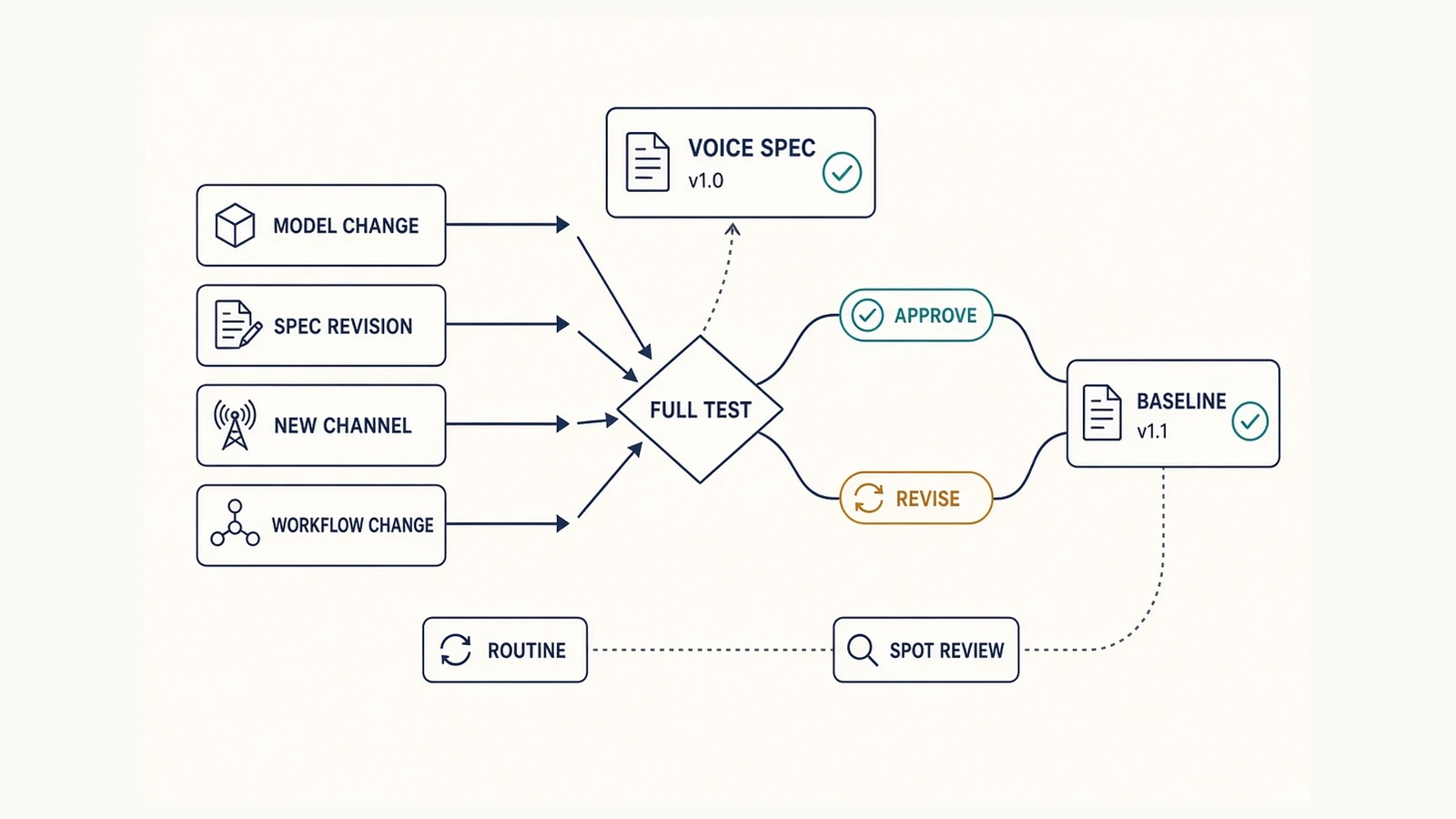
The Regression Process
- Run the same fixed calibration tasks in the updated environment.
- Compare outputs against the applicable Voice Spec criteria and prior accepted baselines.
- Investigate any new failure before changing the spec.
- If the spec or implementation needs to change, update the canonical version first and then distribute the approved revision.
For broader governance, see Production AI Workflow Changes and AI Workflow Testing.
12. Worked E-Commerce Example: “Ridge & Valley Goods”
Consider a fictional direct-to-consumer brand, Ridge & Valley Goods, selling practical outdoor utility gear.
Step 1: Voice Diagnosis & Audience
- Audience: Woodworkers, campers, and craftspeople who value durability, repairability, and functional materials.
- Tone stance: Serious, Respectful, Matter-of-Fact, with a restrained casual edge.
- Observable behavior: Lead with materials, construction, limitations, and care. Avoid lifestyle fantasy and hype.
Step 2: Voice Spec Excerpt
RIDGE & VALLEY GOODS — VOICE SPEC EXCERPT (v1.1)

Objective:
Explain utility, materials, limitations, and care in plain language.

Prohibited terms:
"wanderlust", "adventure awaits", "game-changer", "unleash",
"crafted to perfection", "seamlessly", "must-have", "elevate"

Prohibited structure:
Do not use the "Whether you're [X] or [Y]" marketing opener.

Observable rules:
- Lead with the primary material, hardware, or functional fact.
- State practical limitations plainly.
- Avoid aspirational lifestyle copy.
Step 3: Execution Instruction & Supplied Product Facts
You are writing catalog copy for Ridge & Valley Goods.
Follow Voice Spec v1.1.

Fictional product facts supplied by the brief:
- Product: Waxed Canvas Field Tool Roll
- Material: 18-ounce waxed canvas
- Straps and hardware: heavy cotton webbing straps, solid brass buckles
- Capacity: 10 staggered tool pockets, plus one zippered hardware pocket
- Weather resistance: resists rain and grease; not submersible
- Care: re-wax every two seasons

Use only the supplied facts.
Step 4: The Task
Draft a short product description using only the supplied facts.
Step 5: Illustrative Off-Brand Draft
“Unleash your inner adventurer with the Waxed Canvas Field Tool Roll! Whether you’re heading out for a rugged weekend or working in the garage, this game-changing organizer keeps your essentials secure. Crafted to perfection, it effortlessly elevates your setup. Adventure awaits.”
This draft fails because it uses prohibited phrases, adds unsupported lifestyle framing, and ignores most of the supplied product facts.
Step 6: Illustrative On-Spec Draft
“Built from 18-ounce waxed canvas with heavy cotton webbing straps and solid brass buckles. The roll includes ten staggered tool pockets plus one zippered hardware pocket. The canvas resists rain and grease but is not submersible. Re-wax every two seasons.”
Why it passes:
- Fact fidelity: It uses only facts supplied in the fictional brief.
- Voice behavior: It leads with materials and practical construction details rather than lifestyle imagery.
- Boundary compliance: It states the product limitation and avoids the prohibited vocabulary and opener.
For catalog-scale generation, this voice layer can sit above your existing AI prompts for e-commerce marketing rather than replacing task-specific prompts.
13. Copyable PPF Brand Voice System Template
Copy this template and adapt only the fields your workflow actually needs:
# [BRAND NAME] VOICE SPECIFICATION

## 1. GOVERNANCE
Version:
Last Reviewed:
Document Owner:
Change Notes:

## 2. CORE POSITIONING & COMMUNICATION OBJECTIVE
Brand / Offer:
Primary Communication Objective:

## 3. AUDIENCE & KNOWLEDGE LEVEL
Primary Audience:
Assumed Knowledge:
Key Reader Need:

## 4. TONE ARCHITECTURE
Formal ↔ Casual:
Serious ↔ Funny:
Respectful ↔ Irreverent:
Matter-of-Fact ↔ Enthusiastic:
Specific Tone Words:
Anti-Tone Words:

## 5. OBSERVABLE WRITING BEHAVIORS
Sentence / Cadence:
Paragraph Structure:
Point of View:
Openers:
Conclusions:

## 6. VOCABULARY & PHRASING
Approved Terms:
Brand-Specific Prohibited Words / Clichés:
Prohibited Sentence Structures:

## 7. FORMATTING & LAYOUT
Headings:
Lists:
Emphasis:
Paragraph Length / Density:
Other Formatting Rules:

## 8. CLAIMS, EVIDENCE & ACCURACY BOUNDARIES
How Claims Are Supported:
How Uncertainty Is Stated:
Required Limitations / Disclosures:
Claims That Must Never Be Made Without Evidence:

## 9. APPROVED EXAMPLES & ANTI-EXAMPLES
Format:
Approved Example:
Why It Passes:
Rejected Example:
Why It Fails:

## 10. CHANNEL MODIFIERS
Email:
Long-Form:
Social:
Support / Service:
Other:

## 11. CALIBRATION & CHANGE LOG
Calibration Date:
Model / Platform / Project:
Tasks Tested:
Outcome:
Failures Found:
Changes Made:
14. Frequently Asked Questions
Can I just upload my company’s complete brand guide PDF to ChatGPT?
You can, but a full brand guide may contain substantial material that is irrelevant to writing—logo rules, typography, color systems, and visual-layout standards. For a writing workflow, extract the voice-specific rules into the Voice Spec so the relevant constraints are easier to maintain and review.
How many writing samples should I use?
There is no universal optimum. PPF recommends starting with a deliberately reviewed set that covers the formats you actually publish. Add more examples when they introduce a meaningful voice behavior, audience condition, or channel pattern that is not already represented.
Should I use Custom Instructions or a Project?
For a brand-specific system, a Project is usually the better default because it keeps the brand’s files and instructions in one workspace, and project instructions override global Custom Instructions.
Custom Instructions apply across chats, so they are better for broad preferences you genuinely want everywhere. OpenAI currently allows up to 1,500 characters on Free/Go and 5,000 on Plus, Pro, Enterprise, Business, and Education plans.
Should I build a Custom GPT for brand voice?
Not as a new long-term architecture without accounting for the product transition. As of October 2026, OpenAI says custom GPTs are scheduled to retire on December 11, 2026 under the standard transition timeline and recommends migrating reusable GPT workflows toward Plugins where available.
Eligible Business, Enterprise, Healthcare, and Edu workspaces can also use Skills to package reusable instructions, examples, and supporting resources.
What if output quality drops in a long-running chat?
Return to the canonical Voice Spec and check for conflicting instructions, accumulated revisions, or context that no longer belongs in the task. Then reproduce the task in the same clean environment you use for calibration.
How does this differ from OpenAI model fine-tuning?
OpenAI’s model-optimization documentation treats fine-tuning as a developer/API workflow and includes tone and style among possible use cases. OpenAI also places prompt engineering and evals in the broader optimization process. This article focuses on the no-training configuration path inside ChatGPT: explicit instructions, reference material, examples, Projects, and reusable workflow controls.
15. Next Steps
Start with one controlled pass:
- Select representative samples that your editorial team already approves.
- Run the extraction prompt in Section 4 and review every proposed rule.
- Create Voice Spec v1.0 using the template above.
- Choose the deployment surface—usually a Project for brand-specific work.
- Run the calibration battery before using the setup for routine production.
- Spot-review real outputs and run full regression tests after material changes.
For the broader operating model around this system, continue with Controlled AI Workflow.