
An already-live AI workflow has been changed, or is about to change, after its initial authorization. The operational issue is not merely whether the new configuration “still works” in a general sense; it is determining whether the basis for relying on the workflow still holds, including its prior evidence and current authorization.
A production AI workflow must not inherit prior evidence or authorization merely because its name and general business purpose appear unchanged.
Why a Live AI Workflow Change Is Different
Many conventional software release workflows can rely on explicit deployments, inspectable changes, and recoverable prior versions. Production AI workflows can weaken those assumptions:
- Change without a visible change event: Vendor and provider behavior may change under the hood without an operator deployment, version bump, or usable diff.
- Rollback may not exist: A deprecated provider model or endpoint may no longer be available. Restoring an old prompt does not necessarily restore previous behavior if the underlying foundation model has shifted.
- Evidence becomes stale: A workflow’s authorized boundary might remain identical on paper, but the behavioral evidence that justified that authorization applies only to the configuration that produced it.
- Small changes accumulate: A sequence of individually modest prompt, instruction, or parameter edits may collectively make the existing evidence or operating basis unreliable over time.
To maintain production integrity, changes must be structurally managed. However, this is a distinct operational stage. This methodology does not determine how to perform AI workflow testing, execute post-deployment AI monitoring, conduct active AI workflow troubleshooting, or set generic organizational governance. It answers one question: what has this change invalidated?
What Triggers a Production Change Review
A review should be triggered when a known or suspected production change could affect:
- authorization;
- prior behavioral evidence;
- workflow identity;
- monitoring validity.
Changes generally originate from one of three sources: operator-planned updates, incident-derived repairs, or provider-imposed modifications. The origin of the change does not determine its route.
The PPF Basis Impact Test
Pro Prompt Flow (PPF) does not route production changes solely through generic low/medium/high severity labels, because those labels do not identify which part of the workflow’s existing evidence or authority has stopped being reliable. Instead, PPF assesses impact against the recorded Release Basis and current Operating Basis.
Every relevant production change is assessed against four questions.
Authorization Impact
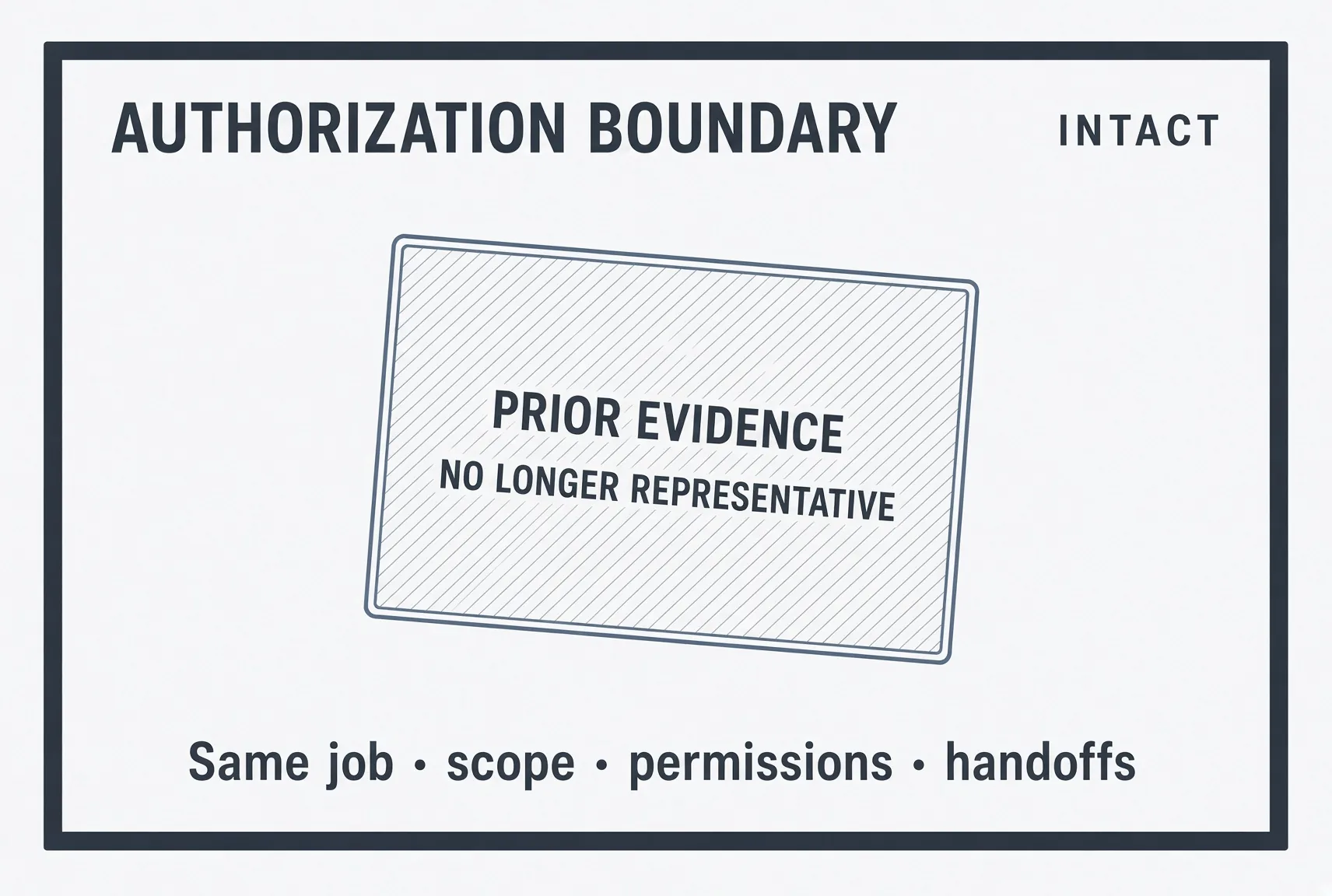
Ask whether the recorded authorized operating boundary remains accurate. This includes the intended use, permitted paths, tools, permissions, runtime controls, and human decision authority. If the recorded authorization statement would have to be rewritten to remain accurate after the change, Authorization Impact is positive.
Evidence Impact
Assess this independently of Authorization Impact. Ask whether the changed configuration could affect behavior or outcomes on paths whose current authorization relied on prior evidence. Authorization scope can remain perfectly intact while the prior evidence supporting it becomes entirely stale.
Workflow Identity
Ask whether the existing process map and recorded Release Basis and current Operating Basis still describe the same operational object. Changing how an unchanged job is performed does not automatically create a new workflow. But if the job, outcome, material handoff structure, or intended case population changes enough that the existing basis no longer describes the object, it cannot be disguised as a normal version update.
Monitoring Validity Impact
Ask whether the changed workflow can still be meaningfully observed under its current Operating Basis. Consider whether existing signals still represent the same behavior, if review sampling still reaches the changed paths, and if current monitoring thresholds remain meaningful.
Monitoring Validity is a cross-cutting completion gate. It does not independently force revalidation of the workflow’s evidence. However, if Monitoring Validity is affected, the Operating Basis must be explicitly repaired or re-baselined before the change disposition closes and before the configuration can return to normal monitoring. Where observation cannot be restored, the disposition cannot close on the current basis, and the workflow requires narrowing to observable paths, reversion where genuinely available, or withdrawal from production.
How the Change Is Routed
Based on the Basis Impact Test, the change is routed to one of four escalation paths. The highest applicable route governs the disposition. Higher routes subsume the obligations of lower routes where those obligations still apply.
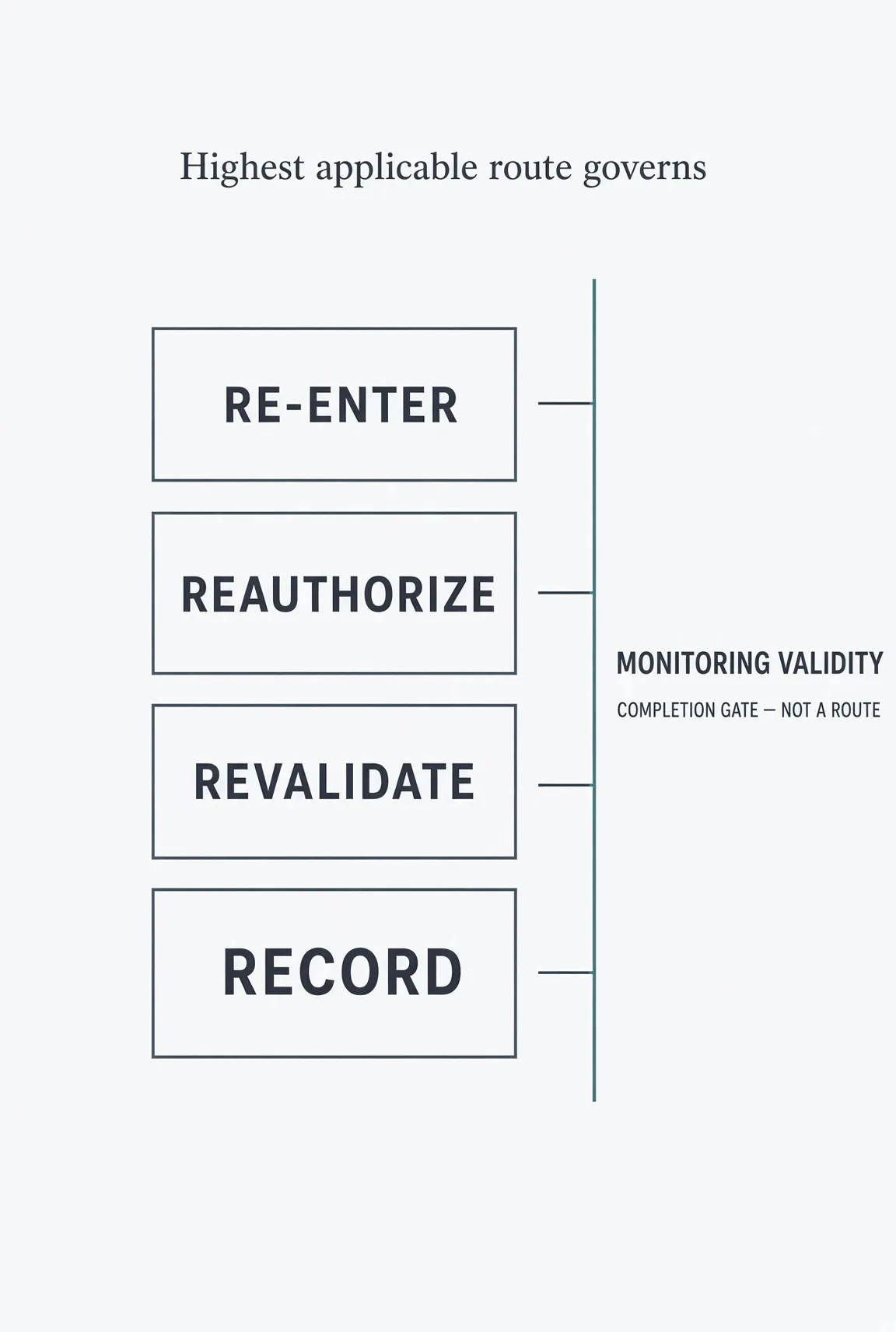
| Route | Triggering Condition | What Remains Valid | Required Handoff | What This Route Does NOT Do |
|---|---|---|---|---|
| RECORD | Workflow Identity intact; no Authorization Impact; no Evidence Impact. | Existing evidence and authorization can remain usable. | None, unless Monitoring Validity requires a basis update. | Does not renew authorization or expand operational scope. |
| REVALIDATE | Workflow Identity intact; no Authorization Impact; Evidence Impact is positive. | The authorized operating boundary remains accurate. | Route the affected paths back through AI workflow testing to re-establish behavioral evidence. | Does not change what the workflow is allowed to do. |
| REAUTHORIZE | Workflow Identity intact; Authorization Impact is positive. | The workflow may remain the same operational object, but the previous authorization boundary does not carry forward unchanged. | May require appropriate owning work (e.g., controlled AI workflow design or AI process readiness reassessment) followed by new authorization through AI workflow testing. | Does not map a new business process. |
| RE-ENTER | Existing Workflow Identity no longer holds against the mapped process and recorded basis. | No automatic carry-over of the previous production authorization. | Depending on what changed, handoffs may involve process mapping, readiness assessment, implementation, or testing. | Is not a penalty; acknowledges a net-new operational object. |
RECORD Is Not a Free Pass
When a change is routed to RECORD, existing evidence and authorization can remain usable. It does not mean the change does not matter. Operator-planned changes are assessed before deployment, and the decision remains falsifiable through later production evidence. RECORD does not expand or renew authorization, and it does not reset evidence currency. Crucially, where accumulated edits raise an impact question, the recorded changes since the last authorization event are assessed together as a single change through the same four impact questions. Any Monitoring Validity requirement must still be resolved before the change-control disposition closes.
When the Change Is Already Live
Not all changes wait for operator approval. A provider may force a model replacement, deprecate an endpoint, or silently alter behavior without a visible change event, a usable diff, or rollback access. Alternatively, an incident-derived configuration change may already be running to contain a failure.
Where no reliable diff exists, you must assess Evidence Impact by dependency. Paths dependent on the changed component should be treated as potentially evidence-affected until sufficient behavioral evidence is re-established.
When a changed configuration is already live but has not yet completed its required route, normal CONTINUE disposition is unavailable. A changed configuration being already live does not create a right to continue operating.
Where continued operation is defensible under the applicable operational constraints (assessed against the affected paths, the exposure created by operating without current evidence, and the availability of a narrower operational alternative), the workflow may be explicitly held in temporary Provisional Operation. Provisional Operation is a PPF-created interim change-control status. It is not authorization. It requires a recorded owner and a firm expiry. There is no universal duration, and indefinite provisional operation is unavailable. Expiry forces disposition.
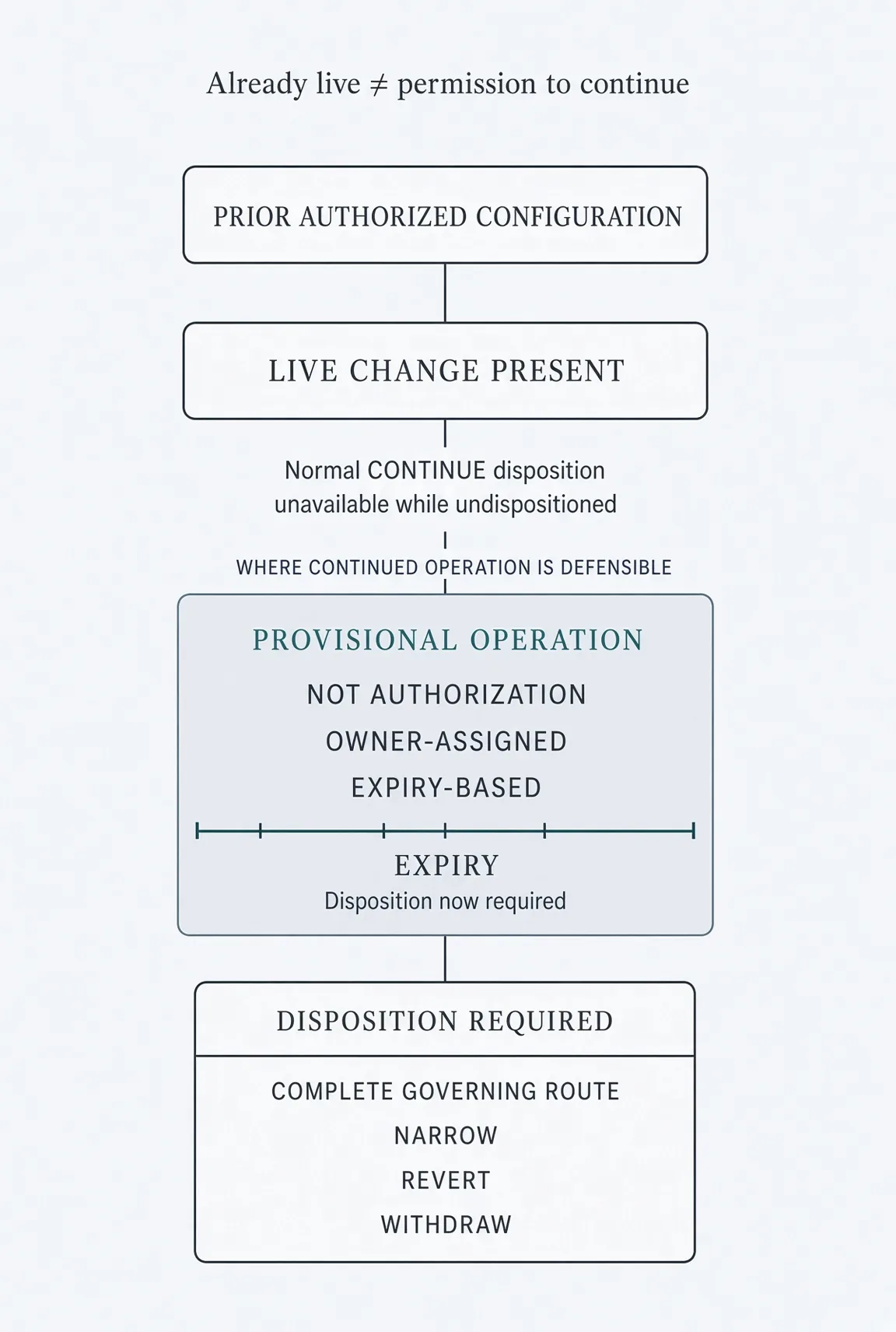
If continued operation is not defensible, or if the required change route cannot be successfully completed, the workflow may need narrowing, intervention, or withdrawal from production (or reverting to the prior authorized configuration, where it genuinely remains available).
Change Control vs Testing vs Monitoring vs Recovery
To maintain clear operational boundaries, do not confuse change control with adjacent lifecycle stages.
| Stage | Primary Question Addressed |
|---|---|
| Change Control | What has this production change invalidated and where must the workflow re-enter? |
| Testing | Does sufficient evidence support a defined production authorization? |
| Monitoring | Does the current authorized live workflow remain acceptable to operate? |
| Recovery | What failed, how is it contained/repaired, and how does service return? |
The PPF Change Control Record
Organizations should document changes using a structured record that isolates the core impact tests from conditional actions.
Core Fields: Required for All Changes
| Field | Required When |
|---|---|
| Workflow/version & recorded Release Basis and current Operating Basis reference | All changes |
| Pending or already-live status | All changes |
| Trigger and origin | All changes |
| Assessment timing relative to deployment | All changes |
| Exact change and affected paths | All changes |
| Authorization Impact | All changes |
| Evidence Impact | All changes |
| Workflow Identity | All changes |
| Monitoring Validity Impact | All changes |
| Highest applicable route | All changes |
| Accountable owner & date | All changes |
| Prior RECORD changes since last authorization event | All changes |
Conditional Fields
| Field | Required When |
|---|---|
| Diff availability | Provider-imposed change |
| Provisional Operation + expiry | Already-live change |
| Rollback/fallback availability | Above RECORD or already live |
| Downstream handoff | Above RECORD |
| Operating Basis re-baselining requirement | Monitoring Validity affected or required by higher route |
| Final disposition | Route cannot complete |
Worked B2B Example
Consider a B2B customer-support triage workflow.
The vendor providing the underlying foundation model announces an immediate deprecation of the current model version, replacing it with a new iteration. No useful diff is provided, and the previous version is entirely unavailable. In the same window, the operator makes a small prompt edit to adjust to the new model’s observed tone.
Applying the PPF Basis Impact Test:
- Authorization Impact: Negative. The workflow’s job, permissions, and human handoff rules remain exactly the same.
- Evidence Impact: Positive. Without a diff and with a new model, previous behavioral evidence on the affected triage/routing paths is no longer reliable.
- Monitoring Validity: Positive. The new model version reports confidence differently, so the existing monitoring signal and threshold are no longer comparable with the previous baseline.
- Workflow Identity: Intact. This is still the same triage process.
Disposition: The highest applicable route is REVALIDATE. Because the change is already live and rollback is impossible, continued operation, if deemed defensible, must be placed into temporary Provisional Operation with a strict expiry. The affected paths are handed off to AI workflow testing, and the Operating Basis must be updated to repair the monitoring signal before normal operation can resume.
Regulatory Context Without Overclaiming
Post-deployment change is recognized as a lifecycle concern across major external standards and regulatory guidance. Those sources establish that the concern is legitimate; they do not validate the PPF methodology described here.
The NIST AI Risk Management Framework (AI RMF) Manage function explicitly includes change management within post-deployment monitoring and addresses third-party risks and system updates. ISO/IEC 5338 defines processes and associated concepts for the AI-system lifecycle and provides processes supporting the definition, control, management, execution, and improvement of AI systems across their lifecycle.
In regulated sectors, the FDA provides recommendations for Predetermined Change Control Plans (PCCPs) for AI-enabled medical devices; a PCCP can describe planned modifications, the methodology used to develop, validate, and implement those modifications, and an assessment of their impact. Furthermore, the EU AI Act defines “substantial modification.” For applicable high-risk AI systems, a substantial modification can trigger a new conformity assessment.
PPF Mandatory Wording Distinction: Under PPF, a change is material when it affects the reliability of existing evidence, authorization, workflow identity, or monitoring basis. This is an operational methodology term, not a legal determination. It is not a synonym for the EU AI Act’s concept of substantial modification. PPF routing is not a legal-compliance determination, nor does every B2B production AI workflow fall under these specific provisions.
Minimum Viable Change-Control Procedure
- Capture the change or suspected change. Document what is changing, its origin, and whether it is already live in production.
- Identify affected paths and current basis. Map the change against the specific paths and the recorded Release Basis and current Operating Basis it touches.
- Apply the four impact questions. Assess Authorization Impact, Evidence Impact, Workflow Identity, and Monitoring Validity Impact independently.
- Assign the highest applicable route. Escalate to RECORD, REVALIDATE, REAUTHORIZE, or RE-ENTER based on the highest triggered impact.
- Set live disposition / Provisional Operation where required. If the change is already live, explicitly hold it in temporary Provisional Operation (where defensible) and set an expiry for the review.
- Complete required downstream handoffs and monitoring-basis update. Route to the appropriate PPF stage and ensure any observation gaps are repaired.
- Close the record and return the accepted configuration to normal monitoring. Conclude the disposition only when all route requirements are satisfied and the updated baseline is secured.
The final route and disposition should be explicitly accepted and recorded by the accountable decision owner; where practical, the decision should not rely solely on the change executor’s own judgement that the change is safe.
If your production AI changes are currently handled through ad hoc tickets, messages, or undocumented approvals, Pro Prompt Flow can help translate this framework into a change-control process fitted to your workflow, evidence, and operating boundaries.
Final Operating Principle
A production AI workflow must not inherit prior evidence or authorization merely because its name and general business purpose appear unchanged.
FAQ
1. Do prompt changes require AI workflow revalidation? A prompt change does not automatically require full revalidation merely because it is a prompt change. If it creates Evidence Impact, affected paths require revalidation. If it changes the authorization boundary or workflow identity, a higher route applies. Monitoring Validity Impact alone requires monitoring-basis correction, not automatic revalidation. Note that accumulated prompt changes can also require collective reassessment.
2. What happens if an AI vendor changes the model? Where no reliable diff exists, identify dependent paths and treat them as potentially evidence-affected until sufficient evidence is re-established. Assess the other Basis Impact dimensions and assign the highest applicable route.
3. Can an AI workflow keep running while a production change is reviewed? Not automatically. If an already-live changed configuration has not completed disposition, normal CONTINUE disposition is unavailable. Continued operation, where defensible (assessed against the affected paths, the exposure created by operating without current evidence, and the availability of a narrower operational alternative), may be temporarily placed under recorded Provisional Operation with an expiry. Otherwise the workflow may need narrowing, intervention, or withdrawal.
4. When does an AI workflow update become a new workflow? A workflow should RE-ENTER when the existing mapped process and recorded Release Basis and current Operating Basis no longer describe the same job, outcome, material human/system handoffs, or intended case population.
5. What is the difference between AI workflow change control and AI workflow testing? Change control determines what a production change has invalidated and where the workflow must route next. Testing actually executes the evaluation to generate behavioral evidence for a specific configuration.
6. Does every production AI workflow change require full reauthorization? No. REAUTHORIZE applies when the recorded authorization boundary would need to be rewritten to remain accurate after the change. Examples may include altered scope, permissions, controls, decision authority, or other authorized operating conditions.
Sources
- NIST AI Risk Management Framework (AI RMF). NIST. https://airc.nist.gov/airmf-resources/airmf/
- NIST AI RMF Playbook (MANAGE 3, MANAGE 4.1, MANAGE 4.2). NIST. https://airc.nist.gov/airmf-resources/playbook/manage/
- ISO/IEC 5338: AI system life cycle processes. ISO. https://www.iso.org/standard/81118.html
- EU AI Act. Official Journal of the European Union. https://eur-lex.europa.eu/legal-content/EN/TXT/?uri=CELEX:32024R1689
- Marketing Submission Recommendations for a Predetermined Change Control Plan for Artificial Intelligence/Machine Learning (AI/ML)-Enabled Device Software Functions. FDA. https://www.fda.gov/regulatory-information/search-fda-guidance-documents/marketing-submission-recommendations-predetermined-change-control-plan-artificial-intelligence
Pingback: AI Workflow Testing: Validate Before Production