
A successful demo is not sufficient production evidence.
A good prompt result, a working proof of concept, a strong model benchmark, or one flawless workflow run may demonstrate capability. It does not, by itself, establish sufficient evidence to authorize an assembled AI workflow for real business operations.
That distinction matters because production exposes more than the model. It exposes the workflow around it: inputs, routing logic, tools, permissions, human gates, integrations, downstream actions, and the consequences of failure.
OpenAI similarly distinguishes general model performance from contextual evaluation: broad benchmarks cannot capture all the conditions that determine whether AI will perform reliably inside a specific business workflow. Its business-evaluation guidance emphasizes defining what good performance means and testing against real-world conditions and relevant edge cases.
AI workflow testing closes the gap between “the system can do this” and “we have enough evidence to authorize this specific workflow to do this in production.”
Table of Contents
- What AI Workflow Testing Must Establish Before Production
- Define the Release Basis Before You Start Testing
- Build Test Scenarios That Represent Real Work
- Test the Entire Workflow, Not Just the AI Answer
- Repeat Tests Where AI Behavior Can Vary
- Use the Right Method to Judge Each Result
- Separate Must-Pass Failures From Overall Quality
- Judge the Residual Risk
- When Is the Evidence Sufficient for a Decision?
- Make the Production Authorization Decision
- Record the Evidence Behind the Decision
- What Pre-Production Testing Cannot Prove
- Frequently Asked Questions
What AI Workflow Testing Must Establish Before Production
AI workflow testing evaluates a specific object:
the assembled workflow immediately before first production authorization.
At this point, the underlying business process should already have been assessed for suitability for AI automation, as covered in our guide on AI process readiness. The workflow itself should already have been built, as covered in SOP automation with AI.
Workflow testing therefore asks a different question.
It does not ask whether the process should use AI. It does not redesign permanent runtime controls such as structured inputs, operating rules, or human gates; those belong to controlled AI workflow design. It does not troubleshoot a workflow that has already failed in production.
Instead, it asks:
Does the built workflow demonstrate enough evidence for the production scope we are considering authorizing?
NIST’s voluntary AI Risk Management Framework explicitly separates testing before deployment from monitoring once an AI system is in operation, and recommends assessing performance or assurance criteria under conditions similar to the deployment setting.
That is the boundary for this article.
Define the Release Basis Before You Start Testing
Testing becomes difficult to interpret when success and failure are defined after the results are visible.
The release basis should therefore be established before the main test cycle.
Proposed authorization scope
Define exactly what the workflow is seeking permission to do.
The proposed authorization scope should describe the relevant tasks, actions, users, systems, and operating conditions.
For example, an AI-assisted customer refund workflow might initially seek authorization to:
- classify refund requests;
- recommend a refund decision;
- route that recommendation to a human agent.
Direct execution of the refund could remain outside the proposed scope.
This is not another process-readiness decision. The question is no longer whether refunds are an appropriate AI opportunity. The question is what this particular built workflow is seeking permission to do.
Acceptance criteria
Acceptance criteria define the conditions the built workflow should satisfy for that proposed scope.
Depending on the workflow, those conditions may cover:
- output correctness;
- consistency;
- routing;
- permission enforcement;
- escalation;
- downstream state;
- operational constraints;
- relevant risk conditions;
- business-performance requirements.
OpenAI’s contextual-evaluation guidance follows the same underlying principle: define what successful performance means for the specific workflow before attempting to measure it.
Release-blocking outcomes
Also define what cannot remain reachable inside the proposed scope.
A release-blocking outcome is a pre-defined failure that can block unrestricted production authorization when it remains possible within the scope being considered.
Here, reachable means that an input, condition, user action, workflow sequence, or dependency state permitted within the proposed authorization scope can still produce the failure.
For the refund workflow, an unauthorized direct refund could be a release-blocking outcome.
That does not automatically mean every possible version of the workflow must be abandoned. The failure might be remediated, genuinely excluded from the authorized scope, or validly contained under a narrower release.
What matters is that it cannot simply be averaged away.
Risk tolerance
Applicable business and process risk constraints become inputs to the release decision.
Workflow testing does not re-decide whether the underlying process is suitable for automation. It translates the relevant constraints into release conditions for this built workflow.
Testing depth should also scale qualitatively with the consequences involved. Higher consequence, greater irreversibility, greater behavioral variability, or difficulty detecting failures generally calls for stronger evidence before authorization.
Bind the evidence to the workflow that was tested
Testing evidence applies to the configuration that actually produced it.
Material changes to a prompt, model, tool, permission, rule, integration, or other component that can affect tested behavior should trigger re-evaluation of the affected paths before the earlier evidence is relied upon for authorization.
That does not mean every trivial edit requires a complete retest. It means authorization should not silently transfer from one materially different workflow configuration to another. After production authorization, managing changes to a production AI workflow requires assessing whether the prior evidence and authorization still apply.
Build Test Scenarios That Represent Real Work
The purpose of a test set is not to accumulate a large number of examples. It is to exercise the conditions that matter to the proposed authorization scope.
Relevant scenarios may include:
- representative normal work;
- meaningful variations in inputs;
- important edge cases and exceptions;
- conditions associated with release-blocking outcomes;
- human handoffs or escalations where relevant;
- tool, integration, or dependency failures where relevant;
- adversarial or security scenarios where the workflow’s risk profile warrants them.
Known-good or reference examples can also provide useful anchors for repeatable evaluation.
OpenAI recommends contextual evaluation using real-world examples and rare but costly edge cases. Anthropic likewise emphasizes task-specific success criteria and balanced evaluation of behaviors that should and should not occur.
The goal is not to test every imaginable input.
There is no universal number of test cases, no universal coverage percentage, and no general pass-rate threshold that makes an AI workflow production-ready.
Coverage should instead become more demanding as the consequence of failure, difficulty of detection, irreversibility, or variability increases.
Test the Entire Workflow, Not Just the AI Answer
Testing an AI response in isolation is not enough when the production object is a workflow.
Where relevant, follow the complete execution chain:
Input → AI behavior → rules/tools → human gate → downstream action or state
The test should examine the parts that can materially affect the business outcome, including:
- information passed between steps;
- tool or action selection;
- permission enforcement;
- routing;
- human escalation;
- downstream state changes;
- error paths.
Anthropic’s agent-evaluation guidance makes a similar distinction between an agent’s final response and the complete trajectory, including tool calls, intermediate results, environment state, and the actual outcome.
In the refund example, correctly classifying a request is not enough if the workflow then calls a payment API that it was never authorized to use.
Test realistic behavior without causing real consequences
End-to-end testing may involve actions that would normally change real systems.
The test environment should therefore represent the production conditions material to the test while isolating unacceptable live consequences.
Depending on the workflow, that may involve:
- a sandbox;
- staging;
- test accounts;
- mock endpoints;
- dry-run execution;
- isolated downstream state;
- another appropriate test mechanism.
The aim is not to build a perfect copy of production. NIST’s Generative AI Profile explicitly cautions that pre-deployment testing may not fully reflect deployment conditions.
The aim is to reproduce the conditions that matter to the decision without accidentally sending customer communications, changing live CRM records, triggering payments, modifying production systems, or causing other unacceptable effects.
Repeat Tests Where AI Behavior Can Vary
Generative AI can produce different behavior across repeated runs.
A single successful run can demonstrate that a happy path is possible. It cannot establish how consistently a probabilistic criterion will behave.
Anthropic explicitly treats each attempt as a separate trial and notes that multiple trials are useful because model outputs vary between runs.
For a probabilistic criterion, repeat testing until the observed variation is sufficient to judge whether that criterion is being met for the proposed scope.
Operationally:
- if observed results remain within the relevant acceptance boundary, the evidence becomes stronger;
- if results repeatedly appear on both sides of that boundary, the available evidence does not yet support a stable authorization judgment for that criterion;
- if a pre-defined must-pass failure occurs, successful runs cannot average it away;
- if remaining uncertainty could materially change the release decision, gather more evidence, remediate the workflow, or narrow the proposed scope.
No universal repetition count follows from this rule.
Use the Right Method to Judge Each Result
Different criteria require different forms of evidence.
Deterministic checks
Use deterministic checks for objective conditions such as:
- schema validity;
- required fields;
- routing;
- permissions;
- exact state changes;
- deterministic business rules.
Automated evaluation
Automated evaluation can efficiently test repeatable assertions or execution behavior across multiple scenarios.
LLM graders
LLM graders can help judge semantic or rubric-based criteria where deterministic rules are insufficient.
They should not be treated as automatically trustworthy simply because they are automated. Their own judgment can vary and may require calibration.
Human or domain judgment
Human or domain judgment may be necessary when nuance, consequence, ambiguity, or specialized knowledge cannot be judged reliably by other methods alone.
OpenAI recommends keeping domain experts involved in contextual evaluation and auditing model-based graders. NIST also notes that independent review and involvement from domain experts or assessors outside the frontline development team can strengthen testing where organizational risk warrants it.
That does not make independent review mandatory for every small workflow. As consequence or uncertainty increases, however, a second qualified perspective may materially strengthen the evidence.
PPF Evaluator Doctrine: Use the evaluation method capable of reliably judging the specific criterion with the least unnecessary complexity.
If testing reveals that a permanent runtime control needs to be redesigned, that design work returns to controlled workflow design.
Separate Must-Pass Failures From Overall Quality
Not all failures should be interpreted through the same aggregate score.
Must-Pass Layer
This layer addresses pre-defined release-blocking outcomes.
If one of those failures is observed and remains reachable inside the proposed authorization scope, high average performance elsewhere does not make it disappear.
A must-pass failure may require:
- remediation;
- exclusion from the proposed scope;
- valid containment;
- or NO-GO.
Performance Layer
This layer addresses ordinary acceptance criteria: what the workflow should perform consistently enough to justify the proposed scope.
Aggregate evidence can help here, but only after release-blocking outcomes have been separately evaluated and accounted for.
PPF Must-Pass Doctrine: A relevant pre-defined severe failure may block unrestricted GO even when aggregate performance looks strong.
This is a PPF operating rule, not an external NIST or vendor standard.
Judge the Residual Risk
Successful tests do not make all uncertainty disappear.
Before authorization, examine what remains:
- unresolved failures;
- known limitations;
- remaining uncertainty;
- consequence severity;
- detectability;
- reversibility;
- available containment.
The core question is whether remaining exposure is defensible for the proposed authorization scope.
A critical rule applies here:
Containment cannot substitute for missing evidence.
A restriction may narrow what is authorized. It cannot manufacture evidence for behavior that remains inside that authorization.
If material behavior has not been adequately evaluated, the options are to test it, remediate it, or exclude it from the proposed scope.
PPF Material Containment Rule
A residual failure path can be treated as materially contained when, with the restriction in force, at least one of these conditions holds:
- the failure can no longer occur inside the proposed authorization scope;
- the failure can be reliably intercepted before an unacceptable or irreversible external effect;
- its credible consequence is enforceably capped at a level the authorizing owner is prepared to accept.
Containment should not rely solely on a safeguard vulnerable to the same known failure mode.
For example, an AI error is not automatically contained because the same AI performs a second check.
A human approval gate is also not automatically effective containment. For the gate to support that conclusion, the reviewer should be able to detect the relevant failure, have the information needed to judge it, have authority to stop or reject the action, and the workflow should not be able to bypass the gate.
In the refund example, routing an incorrect refund recommendation to a human helps only if the reviewer can realistically identify the error before money moves.
When Is the Evidence Sufficient for a Decision?
The goal is not to declare testing universally complete.
The goal is to determine whether the evidence is sufficient for a specific proposed authorization scope.
PPF Evidence Sufficiency Doctrine
Evidence may be considered sufficient when:
- material acceptance criteria within the proposed scope have been meaningfully exercised;
- relevant pre-defined release-blocking outcomes have been deliberately challenged;
- material variations, boundaries, handoffs, and dependencies have appropriate coverage;
- probabilistic behavior has been evaluated enough to judge whether observed variation meets the relevant criteria;
- no unresolved must-pass failure remains reachable inside the proposed authorization scope;
- known limitations, uncertainty, and materially untested behavior are explicit;
- materially untested behavior is excluded from authorization rather than being declared contained.
Testing is not declared universally complete. Evidence is judged sufficient for a defined decision and scope.
There is then a separate authorization precondition:
Sufficient evidence does not itself authorize production. Residual risk inside the proposed scope must be explicitly accepted by the named authorizing owner and recorded.
This separation matters. Risk acceptance cannot turn weak evidence into sufficient evidence.
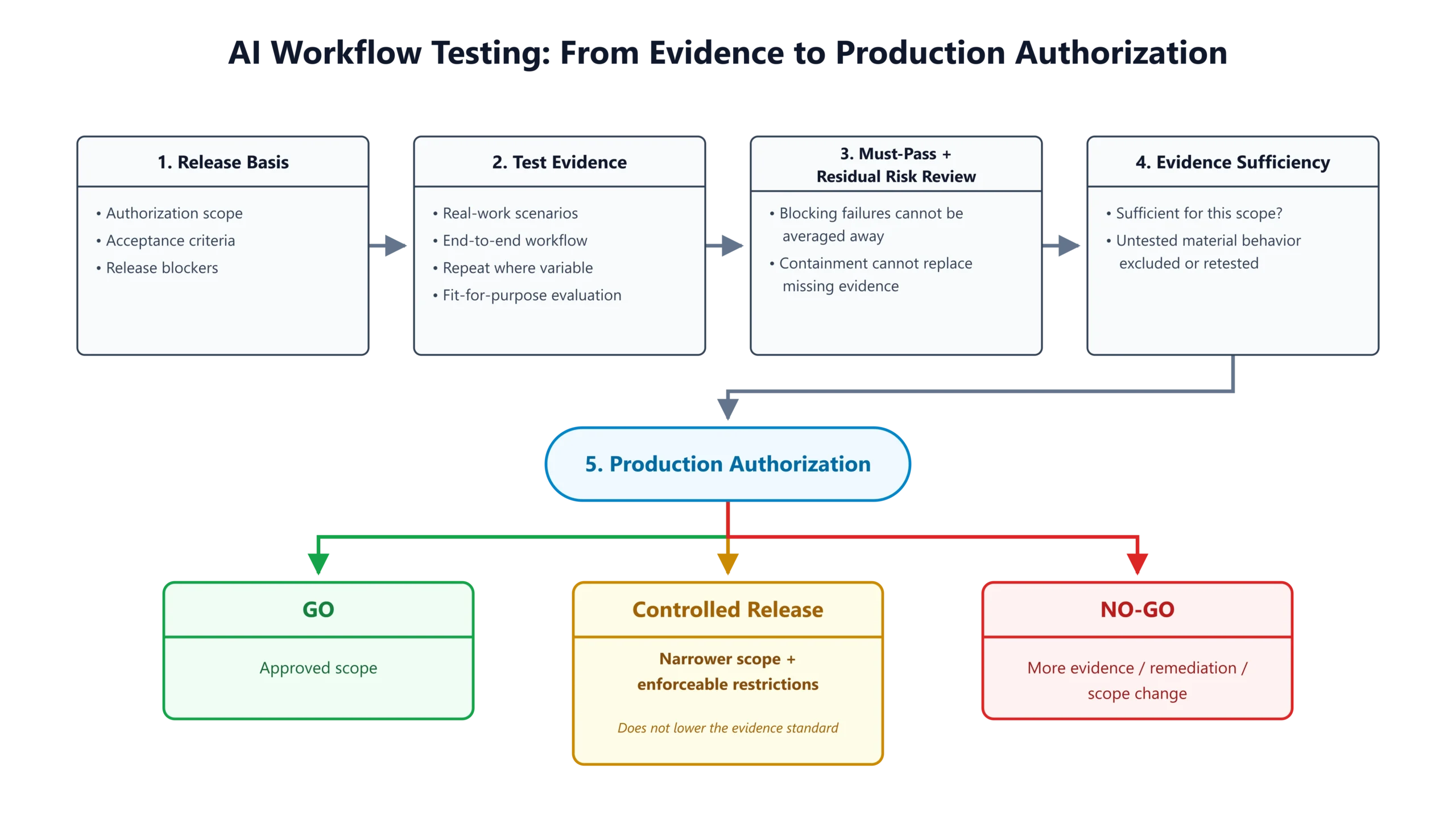
Make the Production Authorization Decision
The PPF Authorization Framework translates the evidence into one of three operational decisions.
GO
Authorize normal production use within the approved scope when the evidence supports that scope and the remaining risk has been explicitly accepted.
After the decision, the proposed authorization scope becomes the authorized scope.
CONTROLLED RELEASE
Controlled Release permits real production exposure under explicit restrictions.
PPF Controlled Release Doctrine: Controlled Release narrows exposure. It does not lower the evidence standard for behavior that remains authorized.
It is useful to distinguish two types of restriction.
Scope-removing restrictions make certain behavior unavailable inside the authorized scope.
For example:
- recommendation allowed, direct execution prohibited;
- particular action unavailable by permission;
- a risky user or task class excluded.
These restrictions can make a failure path genuinely unreachable inside the authorized scope.
Exposure-reducing restrictions reduce how often or how broadly an otherwise permitted behavior occurs.
Examples include:
- fewer users;
- limited traffic;
- a smaller pilot;
- capped volume.
Exposure reduction alone does not make a reachable must-pass failure safe. Lower frequency is not the same as lower per-event consequence.
An exposure or value cap can contribute to valid containment only when it genuinely and enforceably caps the credible consequence at a level the authorizing owner accepts.
Controlled Release is therefore valid only when:
- the narrowed scope has sufficient evidence;
- restrictions are operationally enforceable;
- important restrictions map to identified residual risks;
- those restrictions materially prevent, intercept, or cap the risks they are intended to control;
- no unresolved must-pass failure remains reachable inside the authorized exposure;
- expansion or exit criteria are defined.
If a restriction does not genuinely contain the relevant risk, it cannot justify Controlled Release.
If unrestricted GO is also unsupported, the decision is NO-GO.
For the refund workflow, authorizing recommendation-only use can be a legitimate Controlled Release if direct refund execution is technically unavailable. Merely giving the same unsafe execution capability to fewer agents would not resolve a reachable unauthorized-refund failure.
Expansion is not automatic. Expanding beyond a Controlled Release scope creates a new authorization decision for the added exposure and re-enters the evidence cycle for the newly added behavior, users, actions, or conditions.
NO-GO
Use NO-GO when:
- evidence remains insufficient for the proposed scope;
- a relevant must-pass failure remains reachable;
- residual risk is unacceptable;
- or proposed restrictions fail to make the remaining exposure defensible.
NO-GO does not necessarily mean abandoning the workflow. It means the evidence does not justify the proposed production authority yet.
| Decision | When it fits | Critical condition |
|---|---|---|
| GO | Evidence supports normal production within the authorized scope | Remaining risk is explicitly accepted |
| Controlled Release | Evidence supports a narrower production scope | Restrictions enforceably contain identified risk; weak evidence cannot be hidden by reduced exposure |
| NO-GO | Evidence or residual risk does not justify the proposed exposure | More evidence, remediation, or scope change is required |
Record the Evidence Behind the Decision
A lightweight record helps preserve exactly what was tested, what was authorized, and why.
The PPF Release Evidence Record can include:
- proposed or authorized scope and the tested workflow/version identifier;
- acceptance criteria and release-blocking outcomes;
- rationale for the selected test conditions and scenarios;
- evaluation methods;
- results, including relevant must-pass outcomes;
- known limitations and residual-risk rationale;
- authorization state, authorized scope, and named decision authority;
- containment or rollback evidence where relevant, plus the production-monitoring handoff.
The depth of the record should scale with the workflow’s consequence and complexity rather than becoming unnecessary bureaucracy.
Where an abort, rollback, or containment path is relevant to release, testing should establish whether that path works as required. The record captures the outcome of that check; the record itself does not verify the safeguard.
This article does not teach incident diagnosis, repair, reconciliation, or return-to-service. Those belong to AI workflow troubleshooting.
What Pre-Production Testing Cannot Prove
Even disciplined pre-production testing has limits.
It cannot guarantee:
- future user behavior;
- every unseen input or operating condition;
- every dependency failure;
- future environment or distribution changes;
- future model or provider behavior;
- permanent reliability.
NIST’s Generative AI Profile explicitly recognizes limitations in pre-deployment testing, and NIST’s broader AI risk-management guidance distinguishes pre-deployment evaluation from ongoing monitoring once systems are in operation.
Anthropic similarly treats automated pre-launch evaluation and production monitoring as complementary rather than interchangeable activities.
If a workflow later malfunctions in production, the operational response belongs to AI workflow troubleshooting. Ongoing performance observation belongs to post-deployment AI monitoring.
The purpose of AI workflow testing is therefore not to prove that a workflow can never fail.
It is to replace assumption with explicit evidence, define the exact authority that evidence supports, and make a deliberate production decision whose limits are understood.
Frequently Asked Questions
What is AI workflow testing?
AI workflow testing is the pre-production evaluation of an assembled AI-enabled workflow to determine whether there is sufficient evidence to authorize a defined scope of real production use.
How is AI workflow testing different from testing an AI model?
Model testing primarily evaluates the AI model’s behavior or performance. AI workflow testing evaluates the assembled business workflow around it, including relevant inputs, tools, routing, permissions, human gates, integrations, and downstream actions.
How many test cases are needed before an AI workflow goes live?
There is no universal test-case count. Testing depth should depend on the proposed authorization scope, behavioral variability, failure consequences, and how difficult important failures are to detect or reverse. Where probabilistic behavior matters, one successful run may not provide enough evidence for the decision.
Do I need to retest an AI workflow after changing the prompt, model, or tools?
Material changes that can affect tested behavior should trigger re-evaluation of the affected workflow paths before previous evidence is relied upon. A minor change does not automatically require a complete retest, but authorization evidence should remain tied to the workflow configuration that actually produced it.
What should block an AI workflow from production?
A pre-defined release-blocking failure may block unrestricted production when it remains reachable within the proposed scope—meaning conditions permitted inside that scope can still produce the failure. Strong average performance elsewhere should not erase a relevant must-pass failure.
What is a Controlled Release?
Controlled Release is a PPF authorization state in which an AI workflow enters real production under explicit, enforceable restrictions. The narrowed scope must still have sufficient evidence, and restrictions must genuinely prevent, intercept, or cap identified residual risks.
Expansion is not automatic: widening the authorized scope requires a new authorization decision for the added exposure.
Can limited traffic justify releasing a workflow with a reachable severe failure?
Not by itself. Reducing traffic or the number of users lowers exposure frequency, but it does not make a reachable severe failure disappear. Limited exposure contributes to a release decision only when an enforceable restriction genuinely controls the relevant risk.
Does human approval automatically justify production authorization?
No. A human approval gate provides meaningful containment only when the reviewer can detect the relevant failure, has the information and authority needed to stop or reject the action, and the workflow cannot bypass that gate.
Does passing pre-production testing guarantee that an AI workflow will remain reliable?
No. Pre-production testing supports an authorization decision for a defined workflow configuration and scope. It cannot guarantee future user behavior, unseen conditions, dependency changes, model changes, or permanent reliability. Production monitoring remains a separate lifecycle responsibility.
AI workflow testing is not about proving that a workflow can never fail. It is about replacing assumption with explicit evidence, defining the exact production authority that evidence supports, and making a release decision whose limits are understood.
Pingback: Post-Deployment AI Monitoring for AI Workflows
Pingback: Ecommerce AI Safety Framework: 4 Steps to Test Workflows Before Going Live