
Determining whether to automate a business process with artificial intelligence is an operational evaluation, not a technological endorsement. Demonstrating that a large language model or automated script can generate a plausible draft does not mean the underlying business workflow is ready for implementation. Premature automation can carry existing process weaknesses into the automated workflow, making errors harder to detect, control, and assign.
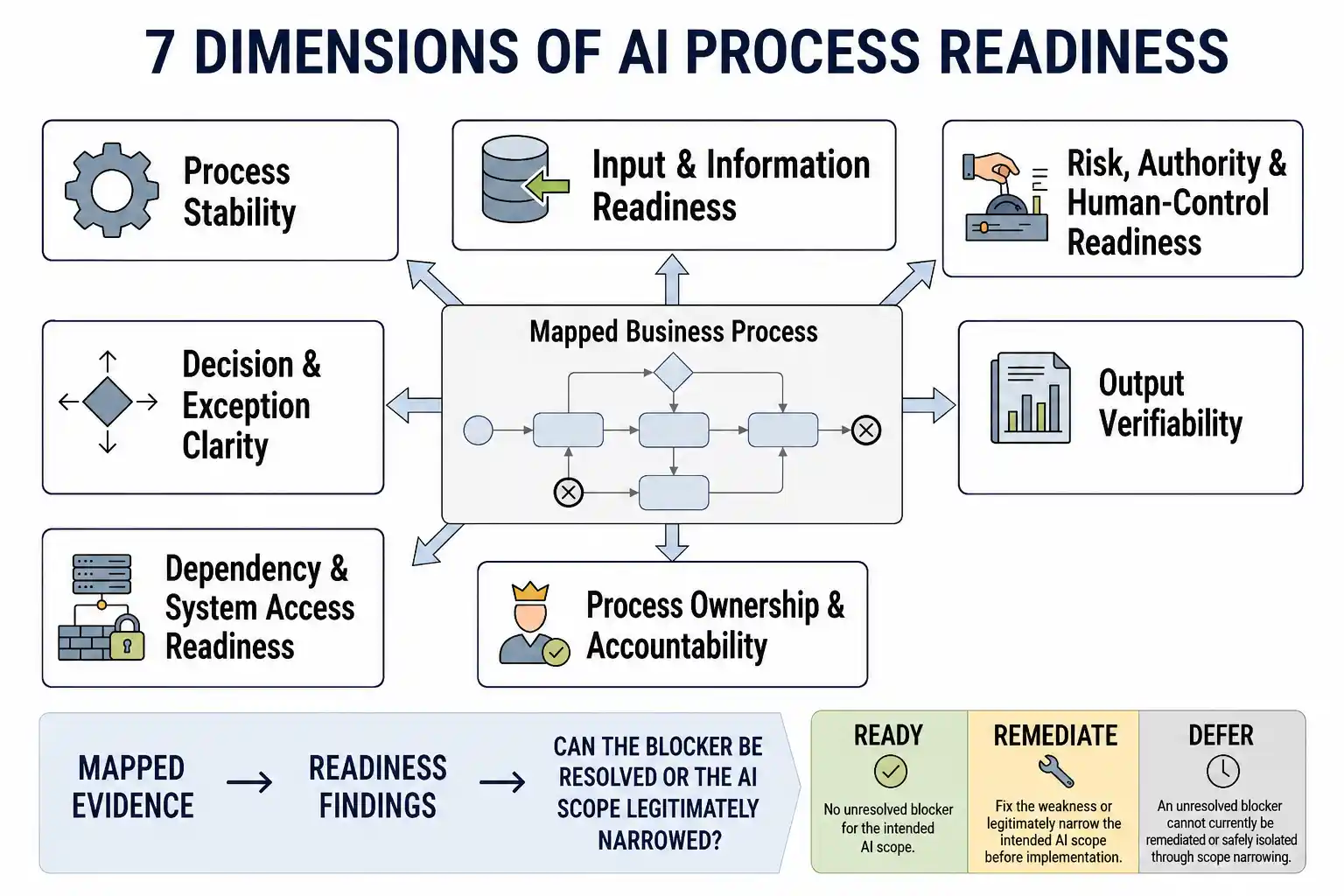
This assessment provides a pre-implementation operational diagnostic for a single, specific business process. It is designed for process owners who have already mapped their workflow and need to evaluate whether that process can safely proceed toward controlled AI implementation. Rather than calculating a generic organizational maturity score, this diagnostic evaluates mapped evidence across seven operational dimensions to reach one of three outcomes: READY, REMEDIATE, or DEFER.
By evaluating documented workflow evidence against clear governance, verifiability, and accountability boundaries, process owners can identify operational blockers, define necessary pre-build remediation, and make evidence-based readiness decisions before committing engineering resources.
Table of Contents
- Before You Assess AI Readiness, You Need a Valid Process Map
- What “Ready for AI Automation” Actually Means
- Stage 1: Is the Process Clear and Bounded Enough to Build Against?
- Stage 2: Can AI Operate Within Acceptable Control Boundaries?
- Stage 3: Can the Business Actually Own and Support the Automated Process?
- Turn Failed Readiness Conditions Into Pre-Build Remediation
- How to Reach the Final Readiness Decision
- Use the Evidence-Based Process Readiness Diagnostic
- What Happens After a Process Is Ready?
- Final Takeaway
- References
- Need a Second Readiness Check?
Before You Assess AI Readiness, You Need a Valid Process Map
Before initiating an operational readiness assessment, an authoritative process map must already exist for the candidate workflow. The diagnostic cannot evaluate abstract workflows, informal work habits, or generalized department goals. It relies strictly on documented, mapped evidence.
A valid process map must explicitly detail:
- Sequential process steps and triggers
- Inputs, data objects, and information sources
- Decision points and explicit branching logic
- Exception paths and escalation procedures
- Responsible roles and operational handoffs
- Systems, tools, and infrastructure dependencies
- Expected outputs and target deliverables
If the mapping artifact lacks enough documented process evidence to perform the assessment, stop the assessment immediately. The process owner must return to Business Process Mapping for AI Automation to construct and validate the required workflow baseline.
A missing or incomplete mapping artifact represents an entry condition failure, not a readiness-assessment result. Conversely, if a sufficiently completed process map itself reveals that the underlying business process contains unstable paths, unclear decisions, undefined exceptions, unassigned ownership, or inaccessible dependencies, those are readiness-assessment findings—not mapping-entry failures.
What “Ready for AI Automation” Actually Means
Operational readiness for AI automation differs fundamentally from broad organizational AI maturity. A business process does not need to be flawlessly optimized to be ready for AI integration, but its operating boundaries, input quality, and control requirements must be sufficiently understood.
The three assessment outcomes are defined as follows:
- READY: The process presents no unresolved operational blocker for the intended AI scope and may proceed directly to controlled implementation design.
- REMEDIATE: The process displays clear operational viability, but specific documented weaknesses require a pre-build operational fix or a narrowing of the intended AI scope before implementation begins.
- DEFER: The process presents significant operational blockers that cannot currently be resolved acceptably through pre-build remediation or scope adjustments.
OPERATIONAL BOUNDARY: A READY determination means a process is ready to enter controlled implementation design. It does not grant authorization for unrestricted, autonomous AI execution.
Stage 1: Is the Process Clear and Bounded Enough to Build Against?
Stage 1 evaluates the foundational mechanics of the process map. If the workflow lacks operational stability, clear data inputs, or identifiable decision boundaries, any AI implementation built upon it will inherit those ambiguities.
Process Stability
Evaluating stability begins by examining the documented step sequences, operator variants, parallel paths, and execution inconsistencies recorded in the process map.
In workflow automation literature, process-automation research consistently treats process variability and exception handling as factors that increase automation difficulty (Wewerka & Reichert, 2021). While an AI workflow does not require rigid, absolute determinism, it demands a sufficiently identifiable and bounded operating baseline for the intended AI scope. When different operators handle the same mapped trigger using contradictory workarounds, automated systems cannot reliably infer correct execution pathways.
Readiness Question: Is the process executed consistently enough to provide a clear, bounded operating baseline for the intended AI scope?
Automating inconsistent or undocumented process variation creates unstable execution paths where automated tasks stall or generate unmonitored errors. When unresolved instability exists, the required operational response is to resolve conflicting operating paths and provide updated mapped evidence showing an authoritative baseline before reassessment.
Input & Information Readiness
Input readiness is audited directly against the data requirements specified in the process map, including named files, data fields, retrieval sources, freshness requirements, and usage restrictions.
Risk management principles emphasize that data availability, suitability for the intended context, and third-party or usage restrictions are critical operational considerations prior to automated processing (NIST AI RMF 1.0). Unstructured information is not automatically a readiness blocker. The relevant question is whether the required information is accessible, sufficiently reliable, and usable for the intended AI scope.
Readiness Question: Is there a known policy, contractual, governance, or quality restriction that prevents using the required information in the intended processing mode?
Missing, corrupt, or policy-restricted inputs lead directly to pipeline failures or compliance breaches. Where input gaps or governance restrictions exist, the process owner must secure explicit usage permissions, establish permitted access pathways, or adjust the intended input scope and provide updated mapped evidence before reassessment.
Decision & Exception Clarity
Auditing decision clarity requires inspecting mapped decision gateways, conditional branching rules, edge-case handoffs, and documented exception triggers.
This dimension focuses strictly on identifiability. It evaluates whether decision logic and exception pathways are explicitly articulated in the map, regardless of whether those steps require human judgment or automated rules. In business process management literature, explicit specification of decision rules, branching logic, and exception handlers is established as fundamental to workflow clarity and execution reliability (Dumas et al., 2018). Evaluating whether human oversight is required belongs to Stage 2, while assigning escalation ownership is handled in Stage 3.
Readiness Question: Are decision criteria and exception pathways explicitly documented in the map, or do they rely on unstated human intuition?
Unmapped decision points introduce the risk of workflow stalling or hallucinated routing, where an automated step encounters an unhandled scenario and selects an unauthorized outcome. Undefined decisions and implicit exception paths normally trigger a REMEDIATE outcome, requiring the business to make decision criteria and exception triggers explicit before reassessment.
Stage 2: Can AI Operate Within Acceptable Control Boundaries?
Stage 2 examines the risk profile and verifiability of the mapped process. Even a clear workflow must operate within acceptable risk, oversight, and output verification parameters.
Risk, Authority & Human-Control Readiness
In an operational context, authority represents what an AI system is permitted to decide, write, or execute without prior human approval. Assessing this dimension begins with mapped evidence covering high-consequence actions, financial commitments, customer-facing communications, and the distinction between reversible and difficult-to-reverse actions.
This evidence outlines the process owner’s operational exposure. Established risk management frameworks highlight that higher operational impact requires proportionally stronger human oversight and intervention capabilities (NIST AI RMF 1.0). Consequential decisions demand robust oversight, requiring the process owner to verify whether human reviewers realistically possess the time, context, and system access needed to intervene effectively.
Readiness Question: Can the intended AI authority be acceptably bounded by human oversight given the operational severity of potential errors?
FRAMEWORK BOUNDARY: This readiness assessment determines whether control is required and operationally feasible; What Is a Controlled AI Workflow? explains how rules, human review gates, and output validation checks are engineered into a controlled AI workflow.
Unmonitored AI authority in high-stakes environments risks severe operational or financial harm. If consequential AI authority cannot be acceptably controlled and the intended AI scope cannot be narrowed so the high-impact action remains human-owned, the assessment yields a DEFER outcome. Otherwise, the process owner must restrict the intended AI authority scope and establish human approval as an operational prerequisite before controlled implementation design.
Output Verifiability
Output verifiability is evaluated against the expected deliverables documented in the process map, including generated reports, structured data records, drafted communications, or calculated decisions.
Risk management frameworks emphasize that AI outputs should be measurable and reviewable against context-appropriate performance and quality criteria (NIST AI RMF 1.0). Verifiability does not require purely objective, single-answer metrics or automated evaluation suites at the diagnostic stage. It requires that the business can review generated outputs against sufficiently clear acceptance conditions to distinguish unacceptable results with adequate reliability for the intended use. Subjective deliverables—such as marketing copy or qualitative summaries—remain viable for automation provided human reviewers have clear standards for acceptable performance.
Readiness Question: Can the business review the generated output against sufficiently clear acceptance conditions to distinguish unacceptable results with adequate reliability?
Vague output criteria allow silent error propagation, where plausible but incorrect outputs pass downstream undetected. If acceptable output conditions are not yet clear enough for reliable review, the process requires remediation before implementation. If they cannot be made sufficiently clear for the intended scope, DEFER may be appropriate.
Stage 3: Can the Business Actually Own and Support the Automated Process?
Stage 3 assesses the organizational anchor points of the process map. Unclear process ownership and inaccessible software dependencies create operational fragility when deploying automated workflows.
Process Ownership & Accountability
Evaluating ownership relies on mapped role assignments across steps, approvals, escalations, and system boundaries.
Established business process management principles emphasize that designated process ownership is essential for operational accountability, performance monitoring, and ongoing process management (Dumas et al., 2018). This dimension evaluates four core operational questions:
- Who owns this business process?
- Who is accountable for its operational outcomes?
- Who confirms that required pre-build remediation has been completed satisfactorily?
- Who owns escalation when the automated workflow encounters an unhandled exception?
Readiness Question: Is there a named, accountable process owner who maintains authority over workflow rules, remediation sign-offs, and exception escalations?
Without clear ownership, operational drift or failures can be harder to detect, escalate, and correct. Missing ownership normally results in a REMEDIATE outcome because an owner can almost always be assigned. The process owner must formally assign operational accountability before moving to implementation design.
Dependency & System Access Readiness
Dependency readiness is evaluated from mapped software applications, required tools, licenses, credential ownership, access permissions, third-party access, and operational handoffs.
This assessment remains strictly at the organizational access level. It verifies whether necessary credentials, software licenses, data access rights, and third-party systems are identifiable, available, and permissioned for the process. It does not evaluate technical integration architecture, custom connector code, or platform selection.
Readiness Question: Are all required systems, tools, and credentials identified in the process map realistically accessible to the business for the intended automation?
Administrative or policy blockages at system boundaries—such as locked legacy databases, denied vendor permissions, or security restrictions—can prevent or materially disrupt the intended workflow. If system access can be obtained through standard administrative channels, the condition is REMEDIATE. If an essential system dependency is permanently inaccessible with no viable workaround, the process must be DEFERRED under the resolvability rule. The required remediation is to establish an accessible dependency path or provide updated mapped evidence showing an acceptable alternative.
Turn Failed Readiness Conditions Into Pre-Build Remediation
An operational assessment should not terminate with a passive “not ready” label. Every remediable weakness should produce a concrete pre-build action. An unresolved blocker that cannot currently be remediated or isolated through scope narrowing should instead produce a DEFER decision and a clear re-evaluation trigger.
To convert findings into actionable work items, map each observation through four components:
- Finding: The documented deficit identified in the process map.
- Condition: The specific readiness dimension governing the deficit.
- Resolvability / Scope Response: Analysis of whether the blocker can be resolved through an operational fix or by narrowing the intended AI scope.
- Pre-Build Action: The concrete operational task or scope adjustment required.
Pre-Build Remediation Matrix
| Finding | Condition | Resolvability / Scope Response | Pre-Build Action |
|---|---|---|---|
| Three internal teams execute mapped customer intake using conflicting informal steps. | Process Stability | Resolvable by standardizing intake workflow. | Resolve conflicting operating paths and provide updated mapped evidence showing one authoritative baseline sequence. |
| Customer records contain restricted PII that policy prohibits passing to external model APIs. | Input & Information Readiness | Scope-adjustable by filtering PII prior to AI processing. | Redesign information boundary to strip PII before ingestion, or restrict AI input scope to non-sensitive fields. |
| Proposed AI system would issue binding customer credit adjustments without human approval. | Risk, Authority & Human-Control | Scope-adjustable by narrowing AI authority to drafting adjustments only. | Re-scope the intended AI boundary to draft-only; establish human approval as an operational prerequisite before controlled implementation design. |
| Exception escalation steps for high-value refund requests rely on unstated manager intuition. | Decision & Exception Clarity | Resolvable by documenting explicit decision criteria. | Make decision criteria and exception triggers explicit, providing updated mapped evidence showing documented threshold rules before reassessment. |
| No operational role is assigned to monitor exception queues or review failed executions. | Process Ownership & Accountability | Resolvable by assigning an accountable process owner. | Formally assign process ownership and exception oversight responsibilities to the Operations Lead before controlled implementation design. |
| Essential legacy ERP database access is denied by IT security with no policy exception path available. | Dependency & System Access | Unresolvable under current constraints; scope cannot bypass essential database. | Halt implementation; establish re-evaluation trigger when ERP access policy is updated or alternate feed exists. |
The evaluation of findings is governed strictly by the resolvability rule: if a severe finding can be acceptably resolved or its risk isolated through scope narrowing, it is classified as REMEDIATE. It leads to DEFER only when resolution and scope narrowing are both impossible under current constraints.
How to Reach the Final Readiness Decision
Reaching a final assessment decision requires evaluating all seven dimensions against clear, non-numerical decision logic.
Process Readiness Decision Model
| Outcome | Decision Condition | Operational Next Step |
|---|---|---|
| ENTRY FAILURE | No valid process map exists for the candidate workflow. | Stop assessment; return to Business Process Mapping for AI Automation. |
| READY | No unresolved blocker remains that prevents the intended AI scope from entering implementation design. | Proceed to SOP Automation with AI to convert the validated process into an executable workflow. |
| REMEDIATE | One or more operational weaknesses exist, but acceptable pre-build fixes or scope adjustments are available. | Execute required pre-build actions or narrow AI scope; update process map and reassess. |
| DEFER | A significant blocker exists that cannot currently be resolved through pre-build fixes or scope adjustments. | Pause AI implementation; establish operational re-evaluation triggers for the process. |
Core Decision Rules
- The Resolvability Rule: Severity alone never determines a DEFER outcome. For every identified blocker, the business must evaluate whether it can be acceptably fixed before implementation, or whether the intended AI scope can be narrowed so the problematic step remains human-owned. If either path is feasible, the outcome is REMEDIATE. Only when neither resolution nor scope adjustment is possible does the assessment yield DEFER.
- The Intended Automation-Scope Rule: Readiness is assessed strictly against the intended AI automation scope. If a specific process step presents an unresolvable AI risk, the process owner can narrow the AI scope—leaving that step under human control—rather than deferring the entire business process.
- The Hard-Blocker Override: A single unresolved blocker can prevent implementation even when the rest of the process appears operationally ready. Readiness is not determined by voting, passing counts, or numerical percentages.
Use the Evidence-Based Process Readiness Diagnostic
To execute this assessment efficiently, process owners evaluate the candidate workflow across the seven readiness dimensions using documented map evidence.
Diagnostic Structure & Dimension Review
The diagnostic evaluates the workflow at the dimension level. To maintain diagnostic integrity, every row must reference documented map evidence. If no mapped evidence exists for a dimension, no valid finding can be recorded.
Use the first two columns as the evidence baseline, then complete Finding / Concern, Resolvable or Scope-Adjustable?, and Required Pre-Build Action for the process being assessed.
| Dimension | Map Evidence Reviewed | Finding / Concern | Resolvable or Scope-Adjustable? | Required Pre-Build Action |
|---|---|---|---|---|
| 1. Process Stability | Step sequences, operator variants, recent process revisions. | |||
| 2. Input & Information Readiness | Input files, data fields, sources, policy/contractual restrictions. | |||
| 3. Decision & Exception Clarity | Decision gateways, branching rules, exception triggers. | |||
| 4. Risk, Authority & Human-Control | Consequential actions, financial limits, reversible vs. irreversible steps. | |||
| 5. Output Verifiability | Expected deliverables, acceptance conditions, review criteria. | |||
| 6. Ownership & Accountability | Responsible roles, approval authorities, escalation paths. | |||
| 7. Dependency & System Access | Software applications, credentials, system access permissions. |
The final READY, REMEDIATE, or DEFER outcome belongs to the overall process and its intended automation scope after all seven dimensions have been reviewed.
What Happens After a Process Is Ready?
Once a process achieves a READY outcome—or completes all required pre-build remediation items—it transitions out of the diagnostic phase and into workflow engineering.
The process owner moves forward to:
- SOP Automation with AI to convert the validated process map and remediation specifications into an executable AI-assisted workflow.
- What Is a Controlled AI Workflow?, to engineer the specific rule engines, human review gates, and output validation checks required for operational control.
- AI workflow testing — validate the assembled workflow before production and determine whether there is sufficient evidence for production authorization.
Final Takeaway
Determining AI readiness is not an exercise in testing model capabilities or chasing technological trends. It is a rigorous operational audit that asks whether a specific business process possesses sufficient clarity, stability, controllability, verifiability, accountability, and accessibility to be automated responsibly.
When evaluating business workflows for AI automation, always enforce the core Pro Prompt Flow sequence:
Map Process → Assess Readiness → Remediate Operational Gaps → Implement Workflow
By demanding documented process evidence, applying the resolvability and scope-narrowing rules, and rejecting pseudo-scientific numerical scores, organizations reduce the risk of failed or uncontrolled implementations and build a sustainable foundation for controlled AI automation.
References
- Wewerka, J., & Reichert, M. (2021). Robotic process automation – a systematic mapping study and classification framework. Enterprise Information Systems, 17(2). DOI: https://doi.org/10.1080/17517575.2021.1986862
- National Institute of Standards and Technology. (2023). Artificial Intelligence Risk Management Framework (AI RMF 1.0). NIST AI 100-1. https://doi.org/10.6028/NIST.AI.100-1
- Dumas, M., La Rosa, M., Mendling, J., & Reijers, H. A. (2018). Fundamentals of Business Process Management (2nd ed.). Springer. https://doi.org/10.1007/978-3-662-56509-4
Need a Second Readiness Check?
If your process is already mapped but you are unsure whether its blockers should be remediated, its AI scope narrowed, or implementation deferred, Pro Prompt Flow can review the process before you move into workflow design. Request a Free Workflow Audit.
Pingback: AI Workflow Testing: Validate Before Production
Pingback: What is a Controlled AI Workflow? The 4-Part B2B Framework